- growth the policy is framed to support
- 7%
- the inflation level NRB is aiming to stay within
- 5.5%
- targeted private sector credit growth
- 11%
- of imports the reserve target must cover
- 7 months
Every year in Shrawan, the monetary policy is reported in Nepal as if it were a budget. Headlines list the targets, the share market reacts for a day, and business owners are left with the same question they started with: does this make my loan cheaper or not?
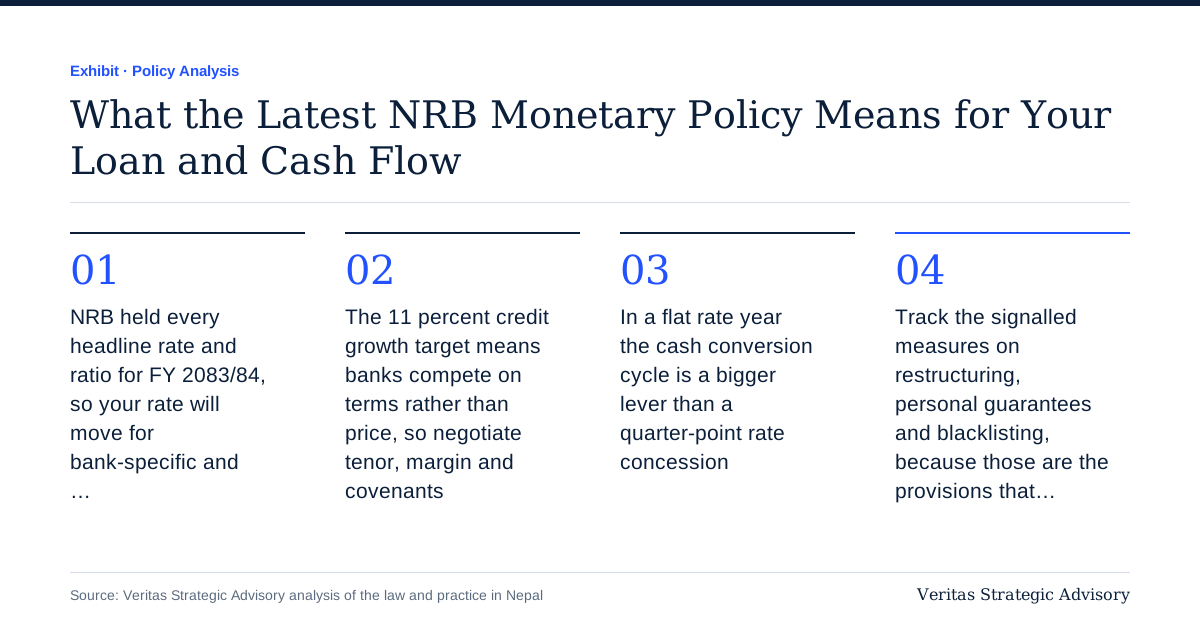
For FY 2083/84 the answer is that the central bank has deliberately chosen to do nothing to the price of money. Nepal Rastra Bank announced the policy on 7 July 2026 and held every headline rate and ratio where it was. That is itself the news, and it has practical consequences for how you should plan a renewal, a new facility or a year of working capital.
This article is about those consequences. If you want the mechanics of how monetary policy transmits into Nepali bank lending generally, we covered that in NRB monetary policy highlights and their impact on business financing.
What did NRB actually change this year?
Very little, and that appears to be the point.
| Instrument | Position for FY 2083/84 |
|---|---|
| Policy rate | Unchanged |
| Bank rate (top of the corridor) | Unchanged |
| Standing deposit facility rate (floor of the corridor) | Unchanged |
| Cash reserve ratio (CRR) | Unchanged |
| Statutory liquidity ratio (SLR) | Unchanged |
| Standing liquidity facility | Existing arrangements continue |
| Interest rate corridor | To be narrowed gradually, as necessary |
The stated targets sit alongside this: support for an economic growth figure of about 7 percent, average consumer price inflation held at around 5.5 percent, private sector credit growth of roughly 11 percent, and foreign exchange reserves sufficient to cover at least seven months of imports of goods and services. These figures are reported consistently across the policy summaries published after the announcement, including this detailed account of the FY 2026/27 policy and this clause-level summary.
One note on figures. Secondary reports of the exact corridor levels do not agree with each other, so we have not quoted a number for the policy rate here. What is consistent across every source, and what matters for a borrower, is the direction: unchanged.
What does an unchanged policy rate mean for your loan?
It means the central bank has removed itself as an excuse, in both directions.
In a year when the policy rate falls, banks have cover to reprice downward and borrowers have a public reason to ask. In a year when it rises, banks have cover to reprice upward and the increase on your statement is not really a negotiation. A flat year is different. Whatever happens to your rate between now and Asar is a function of three things that have nothing to do with NRB's announcement:
Your bank's base rate, which moves with its own cost of deposits, not with a policy announcement.
Your premium over base rate, which is set by your risk grading, your security cover and, honestly, by how much the relationship manager wants to keep your account.
Your own negotiating position, which is strongest when your numbers are clean, current and already in the format the credit department wants.
The third is the only one you control, and a flat policy year is when it does the most work. If the macro story gives nobody a reason to move your rate, the thing that moves it is a well-prepared file.
How much is a rate movement actually worth to you?
Business owners tend to argue hard over a quarter of a percentage point and then lose far more on the structure of the facility. It is worth sizing both.
Take a term loan with NPR 20,000,000 outstanding. The arithmetic is simple: every 1 percentage point on the rate is NPR 200,000 of interest a year on that balance, and a quarter point is NPR 50,000. Over a seven-year facility, assuming the balance reduces steadily, a 1 percentage point saving is worth roughly NPR 800,000 across the life of the loan.
Now take the same business carrying 45 days of receivables it does not need to carry. On annual sales of NPR 120,000,000, 45 days of receivables is about NPR 14,800,000 tied up. Releasing even a third of that is NPR 4,900,000 of cash, which is more than the entire interest saving from a rate negotiation, and it does not require anybody's approval. These are illustrative figures to show the relative sizes, not a claim about any client.
The point is not that the rate does not matter. It is that in a year when the central bank has frozen the rate environment, your cash conversion cycle is the larger lever. We set out how to calculate the requirement properly in how much working capital does your business actually need, and the pattern where growth itself consumes the cash in growing sales, shrinking cash.
Does the 11 percent credit growth target mean money is easier to borrow?
Not in the way most owners hope.
A private sector credit growth target is a ceiling and a direction for the system as a whole. It tells you that the central bank expects lending to expand, which usually means banks are under some pressure to deploy deposits and are willing to compete for good accounts. It does not tell you that your file will be approved.
What it does change is the quality of the competition. In a year with a credit growth target and no rate movement, banks compete on terms rather than headline rate: tenor, moratorium, margin requirement, the security they will accept, the covenants they will live with. Those are the items worth putting on the table at renewal, and they are frequently more valuable than a rate concession.
If your last application was declined, the reasons are usually structural rather than macroeconomic. We listed the recurring ones in five reasons the bank rejected your loan.
Which measures in this policy could actually change your position?
The rate decisions are neutral. Several of the structural signals are not, and these are the paragraphs worth reading closely when the implementing directives are issued:
Restructuring and recovery for sick industries. The policy signals special arrangements for managing non-performing loans in distressed industries and for reviving stressed loans. If your business is in a sector that has been under pressure, this is the provision to track, because the terms of any such scheme will decide whether restructuring is worth applying for.
Unlimited liability from personal guarantees. The policy signals arrangements to address the unlimited personal liability created when a promoter guarantees a company's borrowing. For owner-managed Nepali companies this is one of the most consequential items in the document, because the personal guarantee is usually the real security behind the facility.
Blacklisting after a dishonoured cheque. Measures are signalled to reduce the cases where a single bounced cheque cuts a business off from banking services entirely. A blacklisting event is operationally fatal for a trading business, so any easing of the trigger is worth knowing about.
Share-collateral lending limits. Limits on loans against share collateral are to be set according to each institution's own strength, rather than one uniform cap. If you borrow against a securities portfolio, your limit may now depend on which institution you bank with.
Loan-to-value easing for large electric public transport vehicles. Narrow, but material if you operate in passenger transport.
These are signals in the policy statement. None of them binds a bank until NRB issues the corresponding directive, so the practical advice is to diarise them rather than plan around them today.

What should you do in the next quarter?
A short, concrete list for a flat policy year:
Pull your current sanction letter and read the pricing clause. Confirm whether your rate is base rate plus a fixed premium or a fixed rate, and when it next resets. A surprising number of owners do not know.
Ask your bank for its published base rate history. You are looking at the trend, because that, not the policy rate, is what will move your cost.
Prepare the renewal file before the bank asks. Audited financials, current-year management accounts, an ageing of receivables and payables, and stock position. The file is your negotiating position.
Measure your cash conversion cycle. Days of receivables plus days of inventory minus days of payables. Compare it to last year. This is where the larger money is in a flat year.
Review your personal guarantee exposure. List which facilities you have personally guaranteed and for how much, in advance of any change in the rules.
Diarise the implementing directives. Particularly on restructuring and on guarantees.
Before you commit to a new facility, work through the arithmetic in what to calculate before taking a bank loan rather than the monthly instalment alone.
Frequently asked
Did NRB raise or cut interest rates for FY 2083/84?
Neither. The policy rate, the bank rate and the standing deposit facility rate were all kept unchanged, as were the cash reserve ratio and the statutory liquidity ratio. The policy does state that the interest rate corridor will be narrowed gradually as necessary, which affects how far short-term money market rates can drift from the policy rate, but it is not a change in the level of rates.
Will my bank loan rate still change this year?
It can. Most Nepali commercial lending is priced as a bank's own base rate plus a premium, and the base rate moves with that bank's cost of funds. A flat monetary policy makes a large system-wide move less likely, but it does not freeze your individual rate, and your premium can be reset at renewal based on your risk grading.
What is the private sector credit growth target and does it apply to me?
The policy targets private sector credit growth of about 11 percent for the year. It is a system-level projection and planning figure, not an entitlement. It is useful to you as a signal that banks are expected to expand lending, which generally improves your bargaining position on terms.
Does the policy help a business that is already struggling to service its loans?
Possibly, in time. The policy signals special arrangements for managing non-performing loans in distressed industries and for reviving stressed loans, and separate measures on blacklisting after a dishonoured cheque. Those are statements of intent. What will matter is the implementing directive, including which sectors qualify and on what terms, so monitor the directives rather than acting on the policy statement alone.
Why does this article not quote the exact policy rate?
Because the secondary summaries published after the announcement do not agree on the figure, and we do not publish a number we cannot verify against the primary document. The direction, unchanged, is consistent across all of them and is what matters for planning. For the exact figure, check the full policy text on the Nepal Rastra Bank website.
Should I wait for rates to fall before borrowing?
Timing a facility to a rate forecast is rarely the right basis for an investment decision in Nepal, because the spread you negotiate and the structure of the facility usually outweigh the movement you are waiting for. Decide on the return the investment generates, then negotiate the facility hard.
Where we help
We work with Nepali businesses on exactly the preparation this kind of policy year rewards: building the renewal file the credit department actually wants, measuring and shortening the cash conversion cycle, modelling the effect of a rate or tenor change on covenants and cash, and mapping personal guarantee exposure before the rules change. We provide support and assistance on internal review and control work; we do not perform statutory audits. See financial strategy or get in touch.
General information only, not advice.