
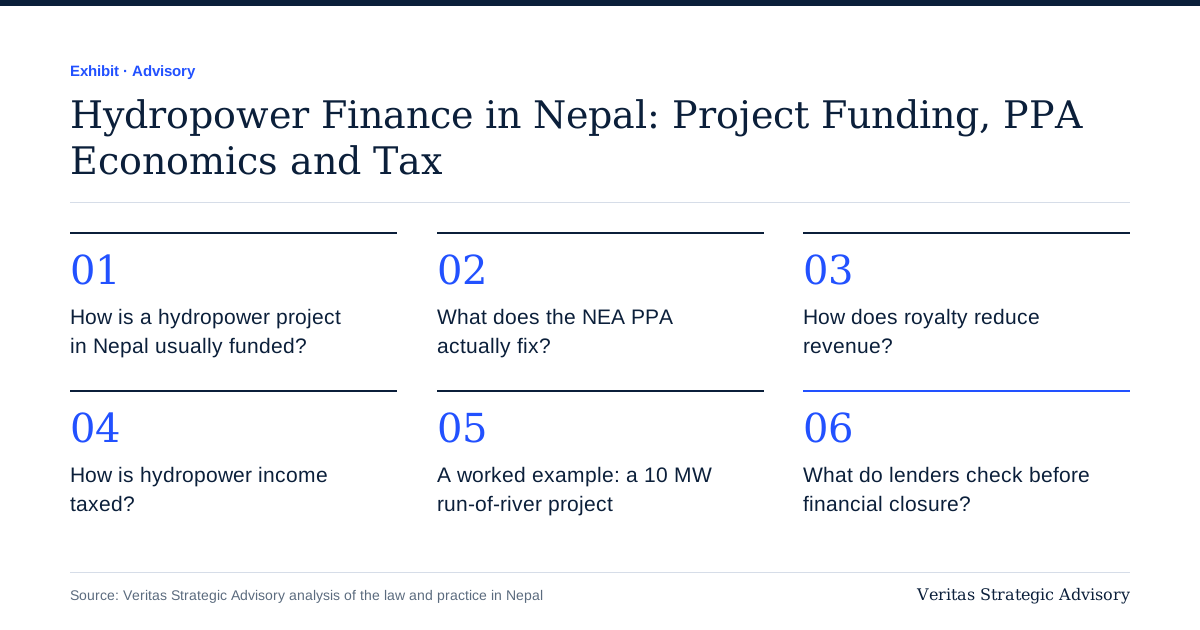
- royalty tiers under the Electricity Act
- 2
- years at the lower royalty rate
- 15
- PPA price escalations in the standard RoR tariff
- 8
- minimum dry-season energy share in one NEA RoR option
- 30%
Hydropower is the sector where Nepali finance, tax and regulation meet most directly. A single project touches the Department of Electricity Development for the licence, the NEA for the PPA, a consortium of banks for debt, the Securities Board for the public issue, and the Inland Revenue Department for tax. Each of these sets part of the economics, and promoters who look at them one at a time tend to discover the gaps late, usually when a lender's model does not match their own.
This guide walks through the money side of a run-of-river (RoR) project in the order lenders look at it. It does not cover engineering or hydrology. The rules described apply as of FY 2083/84 (2026/27), but several of them, especially tax incentives and PPA rates, have changed before and can change again, so check the current Finance Act and NEA guidelines before you rely on any single figure.
How is a hydropower project in Nepal usually funded?
Most private hydropower projects follow the same broad shape:
Promoter equity pays for the study, licensing and early works. This is the riskiest money in the project because it is spent before the PPA and the loan are in place.
Bank debt, usually from a consortium of Nepali commercial banks led by one bank, funds the bulk of construction once the PPA is signed and financial closure is reached.
Public equity is raised through an initial public offering, often once construction is advanced or the plant is close to commercial operation. Shares are commonly offered first to people in the project-affected area under Securities Board of Nepal rules, then to the general public.
The debt-to-equity split is negotiated with the lead bank and depends on the project's size, the strength of the promoters and the risk the bank sees in construction. Treat any ratio you hear as a starting point for that conversation, not a rule.
The lender's first question is simple: will the PPA revenue, after operating costs, royalty and tax, cover the loan repayments with a comfortable margin in every year, including a dry year? That margin is the debt service coverage ratio (DSCR), and almost every term in the loan agreement is built around protecting it. Our guide on what to calculate before taking a bank loan explains how DSCR and similar ratios are tested.
What does the NEA PPA actually fix?
The PPA is the project's only real revenue contract, so lenders read it more carefully than any other document. For RoR projects, NEA's published tariff has for several years used seasonal rates: NPR 8.40 per kWh in the dry season and NPR 4.80 per kWh in the wet season, with 3% price escalations applied up to eight times after commercial operation (SAARC Energy Centre presentation citing NEA rates; the same rates were offered to Upper Trishuli-1, as reported by The Himalayan Times). One NEA RoR option requires at least 30% of contract energy to fall in the dry season.
| PPA term | What it means for the model |
|---|---|
| Dry-season rate (NPR 8.40/kWh) | Each dry-season unit is worth 1.75 times a wet-season unit, so dry-season output drives value |
| Wet-season rate (NPR 4.80/kWh) | Most generation happens here, at the lower price |
| 3% escalation, up to 8 times | Revenue per unit rises for the first years of operation, then stays flat |
| Contract energy by month | Shortfalls against the monthly contract can carry penalties under the PPA |
| Take-or-pay and spill risk | Whether NEA pays for energy it cannot evacuate depends on the PPA wording |
Two practical points follow. First, the escalation stops after the eighth step, so a model that keeps prices rising for the life of the loan is wrong. Eight compounded 3% steps add about 27% to the starting rate (1.03 to the power of 8 is roughly 1.267); if escalation is calculated on the base rate rather than compounded, the uplift is 24%. Read your PPA to see which applies. Second, transmission matters as much as tariff. If the line or substation is delayed, energy that cannot be evacuated may simply be lost, and the PPA clauses on deemed generation decide who bears that.
How does royalty reduce revenue?
Section 11 of the Electricity Act, 2049 charges royalty in two tiers:
| Period from commercial operation | Capacity royalty | Energy royalty |
|---|---|---|
| First 15 years | NPR 100 per installed kW per year | 2% of the average tariff per kWh |
| After 15 years | NPR 1,000 per installed kW per year | 10% of the average tariff per kWh |
The jump in year 16 is large, and it often lands after the main loan has been repaid, which is why some models ignore it. That is a mistake for equity holders: the later years are where the public shareholders expect dividends, and a fivefold increase in energy royalty changes those dividends materially. A pending Electricity Bill could change these terms, so confirm the position at the time you model.
How is hydropower income taxed?
Hydropower companies fall under a concessional corporate tax rate of 20% rather than the standard 25% (summary of Nepal's rates). On top of that, the Income Tax Act, 2058 has given qualifying generation projects a time-limited holiday: full exemption for the first 10 years and a 50% reduction for the next 5 years from commercial operation, provided the project meets a commercial-operation cutoff date written into the law. That cutoff has been moved several times by successive Finance Acts, and different schedules have applied to projects of different dates and types, so the only safe approach is to read the current text published by the Inland Revenue Department against your project's actual dates.
Three tax points catch promoters regularly:
Missing the cutoff. A construction delay of a few months can move a project out of the holiday entirely. Model the tax line both ways and treat the holiday as an upside, not a base assumption, until the commercial operation date is certain.
The holiday covers business income, not everything. Interest earned on idle funds, gains on disposal of assets and withholding obligations on payments to contractors and consultants continue during the holiday. TDS on foreign EPC contractors is a common gap; see our guide to TDS on foreign vendor payments.
Ownership changes. Promoter share sales before or after the IPO can trigger the change-in-ownership rules under Section 57 and affect losses carried forward. Our note on Section 57 change in ownership explains the test.
A worked example: a 10 MW run-of-river project
The figures below are illustrative assumptions for one hypothetical project, chosen to show how the pieces interact. They are not data about any real project.
Assumptions
Installed capacity: 10 MW (10,000 kW)
Contract energy: 60 GWh a year, of which 18 GWh (30%) in the dry season and 42 GWh in the wet season
Tariff: NPR 8.40 dry, NPR 4.80 wet, before escalation
Project cost: NPR 2,000 million, funded 70% debt and 30% equity
Loan interest rate: 10% a year (assumed)
Year 1 revenue
| Line | Calculation | NPR million |
|---|---|---|
| Dry-season sales | 18 GWh x NPR 8.40 | 151.2 |
| Wet-season sales | 42 GWh x NPR 4.80 | 201.6 |
| Total revenue | 352.8 |
Year 1 royalty (first-tier rates)
| Line | Calculation | NPR million |
|---|---|---|
| Capacity royalty | 10,000 kW x NPR 100 | 1.0 |
| Energy royalty | 2% x 352.8 | 7.1 |
| Total royalty | 8.1 |
At the same revenue in year 16, royalty would be NPR 10.0 million of capacity royalty plus 10% of 352.8 million, about NPR 45.3 million in total, more than five times the year 1 figure.
Financing load
Debt of NPR 1,400 million at 10% means about NPR 140 million of interest in the first full year of operation, before any principal. Revenue of NPR 352.8 million less royalty of NPR 8.1 million leaves NPR 344.7 million to cover operating costs, interest and principal. Whether that gives a DSCR the bank will accept depends on the operating cost and the repayment profile, which is exactly the calculation the lender will rerun with a dry-year haircut.
What changes if energy falls
If a dry year cuts dry-season output by a third (to 12 GWh) with wet-season output unchanged, revenue falls by 6 GWh x NPR 8.40, or NPR 50.4 million, to NPR 302.4 million. That single change removes about 14% of revenue while interest stays the same. This is why the dry-season share, not the annual total, is the number lenders press hardest.
What do lenders check before financial closure?
A lead bank will typically ask for, and test, the following before it commits:
A signed PPA with a clear commercial operation date and penalty terms.
A generation licence and the related approvals, with their validity dates.
An independent review of the hydrology and the energy estimate.
An EPC or construction contract with fixed prices and delay penalties where possible.
Land acquisition status and a plan for local and environmental obligations.
A transmission plan showing how and when power will reach the grid.
A financial model with base, dry-year and delay cases, including royalty and tax.
Evidence that promoter equity has been or will be injected before debt drawdown.
Insurance for construction and operation.
A plan for the public issue, including the share reserved for project-affected people.
Promoters who prepare this pack before approaching banks negotiate from a stronger position. The model in item 7 is where most of the negotiation happens, and a model that already includes royalty steps, the tax holiday end date and escalation caps tends to survive review with fewer changes.
How should the accounts be prepared?
Most hydropower companies that raise public equity report under NFRS. Two areas need early attention. Interest incurred during construction on loans used for the project is generally capitalised into the cost of the plant until it is ready for use, which affects both the asset value and later depreciation. Second, the company must decide how to account for the licence and any obligation to transfer the project at the end of its term. Getting these right before the first audit reduces adjustments later; our guide on whether your company needs NFRS covers the scope question, and our practical support on audit readiness explains what auditors ask for.
Where does Nepal's broader hydropower picture fit?
National targets for capacity and export get headlines, but individual project economics still come down to tariff, energy, royalty, tax and financing cost. Our wider piece on Nepal's hydropower potential beyond 83,000 MW looks at the sector view. For a promoter or investor, the useful discipline is to model the project as a business that must service debt in a bad year, not as a share of a national opportunity.
Frequently asked questions
What are NEA's PPA rates for run-of-river projects?
NEA's published RoR tariff has used NPR 8.40 per kWh for the dry season and NPR 4.80 per kWh for the wet season, with 3% escalations applied up to eight times. Rates and conditions can be revised, so confirm the current NEA guideline for your project.
How much royalty does a hydropower project pay?
Under Section 11 of the Electricity Act, 2049, NPR 100 per installed kW per year plus 2% of the average tariff for the first 15 years of commercial operation, then NPR 1,000 per kW plus 10% after that.
Is hydropower income tax-free in Nepal?
Qualifying projects have received a full exemption for 10 years and a 50% reduction for the following 5 years, but only if they meet a commercial operation cutoff date set in the law. That date has changed over time, so check the current Income Tax Act and Finance Act.
What corporate tax rate applies after the holiday?
Hydropower companies are taxed at a concessional 20% rate rather than the standard 25%, subject to the law in force for the year.
Can input VAT on construction be refunded?
Only if the electricity you sell is a taxable supply. Where it is exempt, input VAT on construction cannot be credited and becomes part of project cost, so confirm the treatment under the current Finance Act early.
Why do lenders focus on the dry season?
Each dry-season unit earns 1.75 times a wet-season unit under the standard RoR tariff, so a weak dry season cuts revenue far more than the annual energy figure suggests.
How we help
We build and review hydropower financial models, prepare lender packs, check the tax and royalty assumptions against current law, and support NFRS reporting and audit readiness. Explore our financial strategy capability or contact us to talk through your project.
*General information only, not advice. Rules, rates and tariffs change; confirm the current law and NEA guidelines before making decisions.*


