- a realistic close target for a mid-sized Nepali company within two quarters
- Day 5
- of finance functions in Gartner's 2025 survey use AI for accounts payable automation
- 37%
- of the effort in AI programmes is people and process, in BCG's 10-20-70 rule
- 70%
Ask the owner of a mid-sized Nepali company what the business earned last month, and the honest answer is often "I will know after Ashadh". The accounts are current enough to file VAT by the 25th and deposit TDS. A profit and loss account that someone has reviewed and stands behind exists once a year, when the auditor arrives. Between those dates the owner steers by the bank balance, the sales register and instinct.
Companies that do close monthly usually do so three to six weeks late. By the time the Kartik results are discussed, Mangsir is almost over. The information describes a business that no longer exists.
This article is about closing that gap. It sets out why the close is slow, how to redesign it, where automation and AI make a real difference, and what the phrase "continuous close" should and should not mean for a company in Nepal. It is the seventh article in our series on artificial intelligence for business in Nepal and the second of four on finance, following the CFO's office in 2030.
What a close is for
A close is a promise: on a known date, the numbers for a period are complete, checked and will not change without explanation. Everything else that finance produces rests on that promise. A management report built on an unclosed month is a draft. A forecast built on unreconciled balances starts from the wrong place. A loan application supported by provisional figures invites questions.
The value of a close therefore has two dimensions. One is reliability: can the owner act on the figure? The other is timeliness: is there still time to act? A close that is accurate and six weeks late fails the second test. A close that is fast and wrong fails the first, and is worse.
There is a specifically Nepali reason to care. Tax compliance runs on a monthly clock: VAT returns by the 25th of the following month, TDS deposits within 25 days of month end, and advance income tax in three instalments by the end of Poush, Chaitra and Ashadh, computed on estimated annual income. A company that does not know its year-to-date profit is estimating its advance tax blind, and pays either interest on a shortfall or cash it did not need to part with.
Why the close is slow
Set out the reasons a close takes weeks, and software is seldom on the list. The causes are organisational.
Work is batched to the end. Bills accumulate in a file and are entered in the last week. Bank statements are reconciled once the month is over. Each batch creates a queue, and queues create delay.
Documents arrive late. Purchase bills sit with the purchasing staff or in a site office. Expense claims come in after reminders. Branch and depot returns arrive by courier or as photographs in a messaging group.
There is no cut-off rule. Nobody has decided when the sales ledger closes, how goods in transit are treated, or which month a bill dated the 30th and received on the 8th belongs to. Each month the question is argued afresh.
Accruals are reinvented. Electricity, rent, salaries, bonus, interest and audit fee are estimated from scratch every month, or left out until the bill arrives, which makes monthly profit swing for reasons that have nothing to do with trading.
Reconciliations are treated as year-end work. The VAT ledger is agreed to the returns once a year. TDS payable is agreed to deposits when the auditor asks. Customer and vendor balances are confirmed rarely.
Stock is counted annually. Without a perpetual stock record, cost of goods sold for a month is an estimate, and often a poor one. For trading and manufacturing companies this is the largest single source of unreliable monthly profit.
One person holds the knowledge. The accounts head knows which journals to pass. When that person is on leave or at the tax office, the close waits.
Review is at the end. Errors are found when the trial balance is examined, by which time they are expensive to trace.
Every one of these is a design choice, usually made by default. Buying a tool does not change any of them. This is the finance version of BCG's finding that about 70 per cent of the effort in successful AI programmes goes into people and process, and of the argument in data before algorithms.
Measure before changing
Start by drawing the close as it is. For one month, record every task, who does it, when it starts, when it finishes and what it waits for. A typical result for a trading company with turnover of NPR 30 to 60 crore looks like this (an illustration, not a client):
| Task | Typical day completed (working days after month end) | Waits for |
|---|---|---|
| Sales invoices posted | 1 | Nothing, billing system is live |
| Purchase bills entered | 12 | Bills from purchasing and branches |
| Bank reconciliation, all accounts | 14 | Statements, entry backlog |
| Expense claims and petty cash | 15 | Staff submissions |
| Payroll journal, TDS and SSF | 8 | Attendance from HR |
| VAT ledger agreed, return filed | 18 (25th of the month) | Purchase entry |
| Stock valuation | Not done monthly | Physical count |
| Accruals and prepayments | 20 | Accounts head's time |
| Depreciation | Year end only | Fixed asset register |
| Trial balance review | 24 | Everything above |
| Management report to owner | 30 or later | Review |
Two things appear. The critical path runs through purchase bills and stock, not through the tasks people complain about. And the statutory VAT deadline is acting as the real close date, with management reporting an afterthought.
Redesigning the close
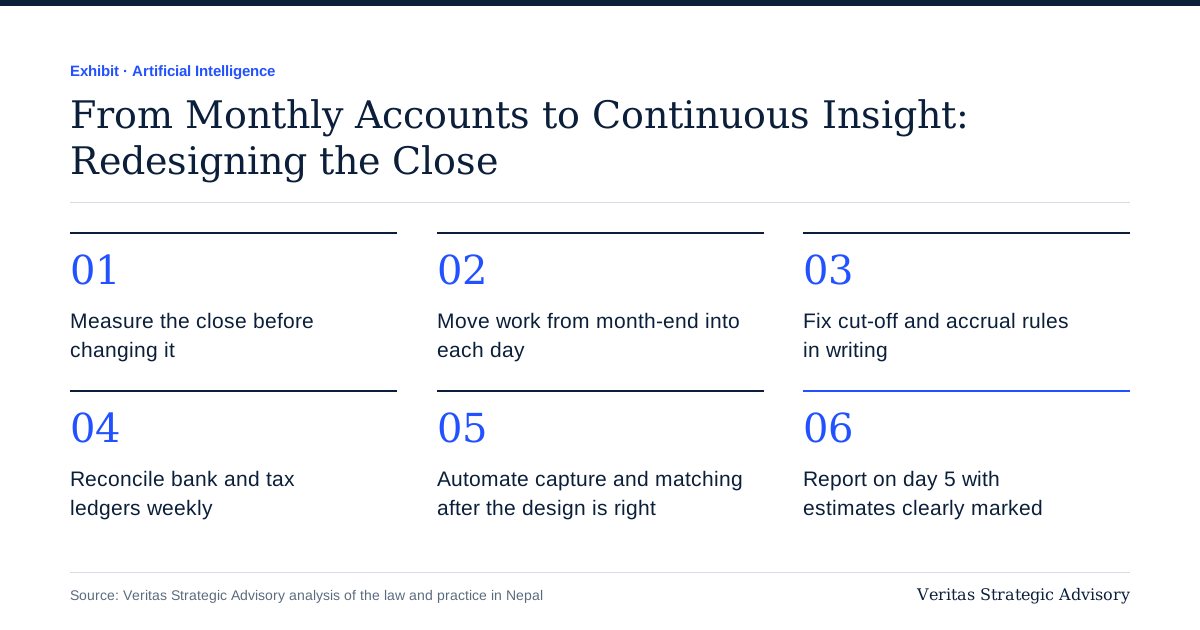
Principle 1: move work out of the month-end
The single most effective change is to stop treating the month-end as the time when accounting happens. Bills are entered on the day they arrive. Bank accounts are reconciled weekly, then daily. Expense claims are submitted on a fixed day each week. By the last day of the month, 90 per cent of the month is already in the books.
Principle 2: a written cut-off
Decide once, and write down:
sales close at the end of the last business day, and invoices are never back-dated;
purchase bills received by working day 2 are booked in the month they relate to, and later arrivals above a set amount are accrued while smaller ones go to the next month;
goods received without a bill are accrued at order price from the goods received note;
branch and depot returns are due on working day 1.
A cut-off rule that is slightly wrong and consistently applied is more useful than a perfect one applied late.
Principle 3: standard accruals and estimates
Build a schedule of recurring accruals with a rule for each: rent and salaries from contracts, electricity from the last three months' average, interest from the loan schedule, bonus and gratuity from the payroll basis, audit and professional fees in twelfths, depreciation from the fixed asset register every month. The schedule is prepared once and rolled forward. True-ups happen when the bill arrives.
Materiality matters here. A management close does not need the precision of audited accounts. Set a threshold, for example 0.5 per cent of monthly revenue, below which differences are carried forward without investigation.
Principle 4: reconcile continuously
A reconciliation done weekly is small. One done annually is an archaeology project. The essential set for a Nepali company:
| Reconciliation | Frequency | Why it matters |
|---|---|---|
| Bank and digital wallet accounts to the ledger | Weekly, moving to daily | Cash is the one figure everyone trusts |
| Sales register to VAT return and CBMS data | Monthly | The tax office sees the same data |
| Purchase register to VAT input credit claimed | Monthly | Disallowed credit is a common assessment issue |
| TDS payable to deposits and e-TDS statements | Monthly | Late deposit carries interest and disallowance risk |
| Payroll to SSF, CIT and salary TDS | Monthly | Errors compound across the year |
| Receivables ledger to customer statements, top 20 | Quarterly | Disputes surface early |
| Payables ledger to supplier statements, top 20 | Quarterly | Missing bills and duplicate payments |
| Stock ledger to physical count, by cycle | Rolling | Monthly margin depends on it |
| Loan balances to bank statements and schedules | Monthly | Interest and covenant reporting |
| Inter-company and related-party balances | Monthly | Groups cannot consolidate without it |
Principle 5: stock without an annual count
For trading and manufacturing companies, replace the single annual count with cycle counting: a few items every day, high-value items monthly, everything at least twice a year. Combined with a properly maintained stock ledger, this gives a usable monthly cost of sales. Where the stock system is not yet reliable, use a standard margin by product group for the monthly close and correct to actual at each quarter's count, stating clearly in the report that margin is estimated.
Principle 6: a calendar with owners
Write the close as a calendar: task, owner, deputy, due day, reviewer. Hold a fifteen-minute stand-up each morning of the close. Publish the close date to the owner and the board and treat missing it as a failure worth explaining.
Principle 7: review as you go
Review moves from the end to the flow. Exceptions are examined daily. A flux review, comparing each ledger balance with the prior month and budget and explaining movements above a threshold, replaces the line-by-line trial balance check.
Where automation and AI help
With the design corrected, tools multiply the gain. Without it, they automate confusion.
| Close activity | What the tool does | What a person still does |
|---|---|---|
| Invoice and bill capture | Reads the document, extracts PAN, VAT, amounts and dates, proposes coding | Clears exceptions, approves new vendors |
| Bank matching | Matches statement lines to ledger entries by amount, date, reference and learned pattern | Investigates unmatched items |
| Accruals | Proposes amounts from history and open orders | Approves, adjusts for known changes |
| Inter-company matching | Pairs entries across entities and flags differences | Resolves disputes |
| Anomaly detection | Flags duplicates, unusual amounts, postings to unusual heads, weekend entries, round sums | Decides which matter |
| Flux analysis | Computes movements and drafts explanations from transaction detail | Confirms the cause with operations |
| Report drafting | Assembles the pack and a first commentary | Edits the message, adds what the data cannot know |
| Close management | Tracks tasks, chases owners, shows status | Removes blockers |
Gartner's 2025 survey found accounts payable automation in use at 37 per cent of finance functions and anomaly detection at 34 per cent: the two close activities where AI is most established. These are also where a Nepali mid-sized company should begin, because most current accounting packages now include some form of both.
Electronic invoicing strengthens the case. As more suppliers issue invoices through software linked to the Central Billing Monitoring System, purchase data arrives structured and the capture step becomes an import (e-billing and CBMS requirements). Bank statement feeds and exports from payment service providers do the same for cash.
Three cautions apply.
Automated matching needs rules about what counts as a match. A tolerance set too wide hides differences. Review the matching rules quarterly.
A drafted explanation is a hypothesis. A model will produce a plausible reason for a variance whether or not it is the true one. Commentary that goes to the owner must be confirmed.
Speed must not remove the second pair of eyes. When a machine prepares and the same person approves without looking, the control has gone. See controls over AI-generated numbers.
What "continuous close" means
The phrase is used loosely. It does not mean that formal accounts are produced every day. It means three things.
Continuous accounting. Transactions are captured, coded, matched and reconciled as they happen, so the ledger is nearly always current.
Daily positions for what matters. Cash, receivables, payables, sales and, where systems allow, stock and gross margin are visible every day in a simple dashboard.
A light periodic close. The month-end still exists, for accruals, estimates, review and sign-off. It takes days, not weeks, because little is left to do.
For most Nepali mid-sized companies the realistic sequence is a close on working day 10 within one quarter, day 5 within two or three, and daily positions for cash and receivables soon after. A close on day 2 or 3 is achievable for service businesses without stock. A fully continuous model is realistic for larger groups with integrated systems.
The flash and the pack
A redesigned close produces two outputs.
The flash report, on working day 2 or 3. One page: sales, collections, cash and bank position, receivables and payables with ageing, order book or pipeline, and estimated gross margin. Figures are provisional and marked so. Its purpose is speed.
The management pack, on working day 5 to 7. Profit and loss against budget and prior year, balance sheet, cash flow, key ratios, working capital, and commentary on what changed and what management proposes to do. Estimates are identified. Its purpose is decision. We set out the contents in what a monthly management report should include.
The discipline of marking estimates is important. An owner who knows that margin is estimated and electricity is accrued on an average will trust the report more, not less, than one who discovers it later.
The Nepal calendar
A close in Nepal has features that imported checklists miss.
The fiscal year and months. The fiscal year runs from 1 Shrawan to the end of Ashadh, and tax periods follow Bikram Sambat months. Many systems and banks report by Gregorian month. Decide which calendar the management close follows and reconcile the other. Most companies are best served by closing on the Bikram Sambat month, because tax returns and the statutory year follow it.
Tax as part of the close. Treat the VAT return and TDS statements as outputs of the close, prepared from closed books, instead of separate exercises that drive it. With a day-5 close, the VAT return is ready three weeks before its deadline.
Advance tax. The close before each instalment date, at the end of Poush, Chaitra and Ashadh, should include a year-end profit estimate and tax computation.
Festival months. Dashain and Tihar remove two to three working weeks in Ashwin and Kartik. Plan the close calendar around them, and complete as much as possible before the holidays.
Year end. A company that closes monthly arrives at Ashadh with eleven months already reviewed. The year-end close and audit preparation shrink accordingly, and the three-month window for the annual return stops being a scramble.
Lender reporting. Banks ask for quarterly financials and stock and receivable statements. A reliable monthly close makes these routine and consistent with what was reported the previous quarter.
What a faster close is worth
The benefit is rarely a saving in salaries. It shows up as:
Earlier decisions. A margin problem seen on day 5 can be acted on within the month. Seen on day 35, it has run for two months.
Working capital. Daily visibility of receivables and stock typically releases cash, and a company paying 11 to 13 per cent on working capital loans feels each day of reduction.
Tax accuracy. Fewer mismatches between returns and books, correctly estimated advance tax, and interest and penalties avoided.
A cheaper, calmer audit. Schedules already exist.
Credibility with lenders. Timely, consistent quarterly figures support renewals and limits (why banks reject loans).
An illustrative calculation: a distributor with NPR 50 crore turnover and average receivables of 75 days that brings collection down by five days through weekly ageing review frees about NPR 68 lakh of cash. At 12 per cent that is roughly NPR 8 lakh a year in interest, before any benefit from better margin decisions. The cost is mostly management attention.
From ground level to policy level
On the ground, the obstacle is habit. The junior who enters bills in a batch, the storekeeper who sends the goods received notes weekly and the salesman who holds the collection receipts for a few days are each behaving reasonably within the present design. Changing the close means changing their routines, and that needs the owner's visible support.
At company level, the close is a governance matter. Under the Companies Act 2063 directors are responsible for proper books of account. A board that receives results six weeks late is discharging that duty weakly.
At policy level, the state is shortening its own cycle. The Inland Revenue Department's e-billing system gives it invoice data in near real time, and the 2083/84 budget announced an AI-driven e-assessment system for risk-based audit selection. When the tax office can see a company's sales the day they happen, a company that sees its own results annually is at a disadvantage in any discussion (the data-driven tax authority). Nepal Rastra Bank's supervision of lenders points the same way, toward more frequent and more data-based monitoring of borrowers.
The role of consulting and advisory firms
Close redesign is a long-established consulting product. The large firms publish benchmarks for days to close and offer finance transformation programmes that combine process redesign with close-management and reconciliation software. Their surveys show finance leaders reporting returns from AI in this area, and their published work on the 10-20-70 pattern is a useful reminder of where the effort goes.
Two cautions for a mid-sized company. Benchmarks drawn from multinationals with shared service centres are of limited use to a family-owned distributor in Nepal. And a close-management tool does not create a close: where the foundations are missing, the money is better spent on the stock ledger and reconciliations.
What an adviser usefully does here is modest and practical: map the present close, design the calendar and rules with the team, set up the reconciliation and accrual schedules, configure the automation the software already has, run the first two or three closes alongside the team, and then step back.
This is work we do. Our bookkeeping and virtual CFO services include a monthly close to an agreed date, our management reporting work builds the pack, and our process automation work connects the steps. For companies that keep the function in-house, we redesign the close and train the team as part of our finance function work. We do not sell software.
The next 90 days
Days 1 to 30. Map the current close task by task with dates. Identify the critical path. Write the cut-off rules and the accrual schedule. Start weekly bank reconciliation. Announce a target close date.
Days 31 to 60. Run the first close to a calendar with named owners, aiming for working day 12. Begin same-day entry of bills. Reconcile the VAT and TDS ledgers to returns. Issue a first flash report. Turn on bill capture and bank matching in the accounting software.
Days 61 to 90. Bring the close to working day 8, then set day 5 as the standing target. Start cycle counts of stock. Add flux review and an anomaly report. Present the owner with a management pack that marks its estimates, and agree what decisions it will be used for.
Frequently asked questions
How fast should a Nepali company close its books?
Working day 5 to 7 is a sound target for a mid-sized company with stock, and day 3 for a service business. Start from wherever you are and remove a few days each month.
Do we need new software to close faster?
Usually not at first. Most delay comes from batching, late documents and missing rules. Existing packages handle a day-5 close. Software matters more when moving toward daily positions and multi-entity consolidation.
Can AI close the books by itself?
No. It can capture, match, propose accruals and draft commentary. Estimates, cut-off judgements, review and sign-off remain with people, and someone must answer for the result.
What if our stock records are unreliable?
Close on an estimated margin by product group and say so in the report, while building cycle counting and a proper stock ledger. Do not wait for perfect stock data to begin.
Should we close on Bikram Sambat or Gregorian months?
For most companies, Bikram Sambat, since VAT, TDS and the fiscal year follow it. Groups reporting to foreign parents may need both, with a reconciliation.
Is a management close the same as audited accounts?
No. A management close uses estimates and materiality thresholds for speed. It should be consistent with the statutory accounts, and differences at year end should be small and explainable.
How does a faster close help with tax?
Returns are prepared from reviewed books, mismatches are caught monthly, advance tax is estimated from real year-to-date profit, and documents for any enquiry are already organised.
Who should own the close?
The head of finance, with the owner or managing director as sponsor. Without the sponsor, operations will not send documents on time.
*This article is general guidance, not professional advice. Timings, thresholds and the worked example are illustrative and should be adapted to each business. Tax deadlines reflect our understanding of rules for FY 2083/84 and should be confirmed for your situation.*