- of tax administrations in the OECD's 2025 survey of 54 jurisdictions report using AI
- 72%
- is the general limit for an amended assessment under section 101
- 4 years
- data matches a company can run on itself each month
- 6
For most of the history of income tax and VAT in Nepal, whether a company was examined depended on a small number of things: its size, its sector, whether it claimed a refund or declared a loss, whether someone had informed on it, and the judgement of the officer who held its file. A company could carry an inconsistency between its VAT returns and its accounts for years without anyone noticing, because nobody had the two documents side by side.
That world is ending. The change is not a new law or a higher rate. It is that the tax office now holds most of the data needed to check a return without asking the taxpayer, and is acquiring the means to check all returns, not a sample. This article explains what is changing, what the Inland Revenue Department can see, how risk scoring works in principle, and what a company should do about it. It is the tenth in our series on artificial intelligence for business in Nepal.
One caution at the outset. The department does not publish its selection criteria or the design of its systems, and nothing here is inside knowledge. What follows is drawn from published budgets, strategy documents and presentations, from what tax administrations elsewhere have disclosed, and from the logic of the data itself.
The global direction
The OECD's 2025 survey of tax administrations in 54 jurisdictions found about 72 per cent reporting the use of artificial intelligence. The most common applications were detecting evasion and fraud, assessing risk to select cases, and virtual assistants for taxpayer services. These are self-reported figures and "AI" covers everything from simple rules to machine learning, but the direction is plain.
Some examples that administrations have described publicly:
India has built its GST system around invoice matching, where a buyer's input credit depends on the seller's reported invoice, and uses analytics to identify fake invoicing chains. Income tax assessments have moved to a faceless, system-allocated model, and taxpayers receive an annual information statement showing what the department already knows about them.
Brazil and several other Latin American countries have required electronic invoicing for years, giving administrations transaction-level data in real time.
The United Kingdom has long operated a data-matching system that combines returns with banking, property, company and other third-party data to score risk.
Australia runs extensive data-matching programmes and publishes benchmarks by industry, telling small businesses what ratios are normal for their trade.
The United States has announced the use of AI to select large partnerships and complex entities for examination.
The pattern is consistent: electronic invoicing provides the data, third-party reporting provides the cross-check, and analytics does the selection. Nepal has the first, a growing amount of the second, and has announced the third.
There is a cautionary side. The Netherlands' childcare benefits affair, in which a risk-scoring system wrongly marked thousands of families as fraud suspects, brought down a government in 2021. Australia's automated debt recovery scheme, known as Robodebt, was found unlawful. Automated selection without human review and a right to explanation can go badly wrong, and that matters for how Nepal builds its system.
Where Nepal stands
Electronic filing and the integrated system. Returns for income tax, VAT, TDS and excise are filed online against a Permanent Account Number. The department therefore holds every return in structured form.
E-billing and the Central Billing Monitoring System. Large taxpayers and prescribed sectors must issue invoices through approved software that transmits invoice data to the department. The turnover threshold, reported at NPR 25 crore, is expected to be lowered in phases. For those taxpayers, the department sees each sale as it is made (e-billing and CBMS requirements).
E-TDS. Withholders report each payment and the payee's PAN. Every TDS entry is therefore a third-party report of someone else's income.
Customs. Import and export declarations are recorded in the customs system against the importer's PAN, with values, quantities and classifications.
The strategy. The department's reform and domestic revenue mobilisation plans describe an automated audit selection module using risk indicators and weightages, annual review of risk criteria, near-real-time use of billing data, and integration with customs data and the National ID. The federal budget for 2083/84 announced an "AI-driven e-assessment system for risk-based investigation and audits".
What is not known. How far the system has been built, which indicators it uses, how much is rules and how much is statistical modelling, and when it will govern selection in practice. Announcements run ahead of implementation everywhere. A prudent taxpayer should assume the capability is arriving and plan accordingly, without assuming it is already complete.
What the tax office can see
It is worth listing, source by source, what can be assembled about a single company without asking it for anything.
| Data source | What it shows | What it can be matched against |
|---|---|---|
| The company's own VAT returns | Monthly sales, purchases, input and output tax | Income tax return, CBMS data, customs |
| Income tax return and attached statements | Annual revenue, expenses, profit, balance sheet | VAT returns, TDS, prior years, sector norms |
| CBMS e-billing data | Each invoice issued | VAT returns, buyers' purchase claims |
| Other taxpayers' purchase records | Purchases from this company, by PAN | This company's declared sales |
| E-TDS statements filed by this company | Payments to suppliers, staff, landlords, professionals | Expenses claimed, payees' declared income |
| E-TDS statements filed by others | Income received by this company | Its declared revenue |
| Customs declarations | Imports and exports by value and quantity | Purchases, stock, sales, VAT on imports |
| Excise records | Production and removals, for excisable goods | Sales and stock |
| Company Registrar filings | Shareholding, directors, capital, annual returns | Related parties, dividend and share transactions |
| Social Security Fund and CIT contributions | Staff numbers and payroll | Salary expense and salary TDS |
| Land revenue and vehicle registration | Asset purchases by the company and its owners | Declared income and asset schedules |
| Bank and financial information | Available on request or through reporting arrangements | Turnover, loans, undisclosed accounts |
| Financial statements submitted to banks | The picture given to lenders | The picture given to the tax office |
No single item is new. What is new is the possibility of matching them automatically for every taxpayer. The officer no longer needs a reason to look. The system looks at everyone and tells the officer where the differences are.
How risk scoring works
The mechanics are simple in principle, and understanding them removes much of the mystery.
Rules. Fixed tests applied to every taxpayer. Does annual VAT turnover equal income tax turnover, after allowing for exempt and export sales? Do purchases claimed from each supplier match what that supplier reported selling? Is TDS deducted consistent with expenses claimed? Rules are transparent and catch plain inconsistency.
Ratios and peer comparison. Each taxpayer's gross margin, net margin, input-output ratio, wage share and stock turnover compared with others in the same sector and size band. A trader reporting a gross margin of 2 per cent in a trade where 8 to 12 per cent is normal will stand out.
Trends. A taxpayer compared with its own history. Sudden falls in margin, persistent VAT credit carried forward for years, losses year after year alongside growing assets.
Networks. Links between taxpayers through invoices, common directors, addresses and bank accounts. This is how chains of fake invoices and circular trading are found.
Statistical models. Where an administration has outcomes from past audits, it can train a model to predict which returns are most likely to yield additional tax. This is the "AI" in the strict sense, and it needs years of well-recorded audit results.
Each test produces a score. Scores are weighted and summed. The highest-scoring cases go to officers. In a mature system, lower-scoring discrepancies generate automated letters or prompts asking the taxpayer to explain or correct.
Two consequences follow. Selection becomes less dependent on who you are and more on what your data looks like. And taxpayers whose data is consistent, with margins in a credible range, should in principle be troubled less.
What gets flagged
From the logic above and from how selection works under the existing system (how the IRD selects companies for tax audit), these are the patterns most likely to raise a score.
Mismatch between VAT and income tax turnover. The commonest and simplest. Differences arise legitimately from exempt sales, timing, advances and other income, but an unreconciled difference reads as suppressed or misreported sales.
Input credit without matching supplier sales. If a buyer claims VAT on a purchase that the supplier has not reported, the claim is at risk, even where the buyer acted in good faith.
Sales below what e-billing data shows. For taxpayers on CBMS, the return should agree with transmitted invoices, including credit notes.
Imports inconsistent with sales and stock. Goods imported, per customs, that do not appear as purchases, stock or sales.
Expenses without TDS. Payments for services, rent, contracts or professional fees on which tax should have been withheld. Under the Income Tax Act the consequences include the tax itself, interest and potential disallowance (TDS rates for 2083/84).
Payroll inconsistencies. Salary expense that does not agree with salary TDS and Social Security Fund contributions.
Low or negative margins. Persistent losses, or margins far below sector norms, particularly in a business that is visibly expanding.
Continuous VAT credit. A trader in standard-rated goods whose input tax exceeds output tax year after year.
Related-party dealings. Sales, purchases, loans and fees between companies with common ownership, especially at prices that move profit to a lower-taxed or loss-making entity.
Foreign payments. Service fees, royalties and interest paid abroad, where withholding under section 88 and VAT reverse charge may apply (TDS on foreign vendor payments).
Lifestyle and assets. Property and vehicle acquisitions by owners out of proportion to declared income and dividends.
Two sets of numbers. Financial statements given to a bank showing higher turnover or profit than the tax return. As lenders and the tax office move toward shared data, this old practice becomes very dangerous.
What changes for the taxpayer
More enquiries, narrower in scope. Expect questions about a specific mismatch, perhaps system-generated, in place of a general examination. These are quicker to answer if the reconciliation exists, and awkward if it does not.
Earlier detection. With monthly data, a discrepancy can be queried within months. That is helpful for honest errors, because interest runs for less time.
The four-year window matters more. An amended assessment under section 101 may generally be made within four years. A system that can run every match for every open year makes it more likely that old inconsistencies are found before the period closes.
Less room for explanation by relationship. A system-allocated, data-based query is answered with documents and reconciliations.
Good-faith buyers are exposed to suppliers. Where input credit depends on the supplier's reporting, choosing compliant suppliers and checking their PAN and VAT status becomes part of purchasing.
Sector benchmarks become a fact of life. If your margin is unusual for a sound reason, such as a different business model or a start-up year, have the explanation ready.
The six matches to run every month
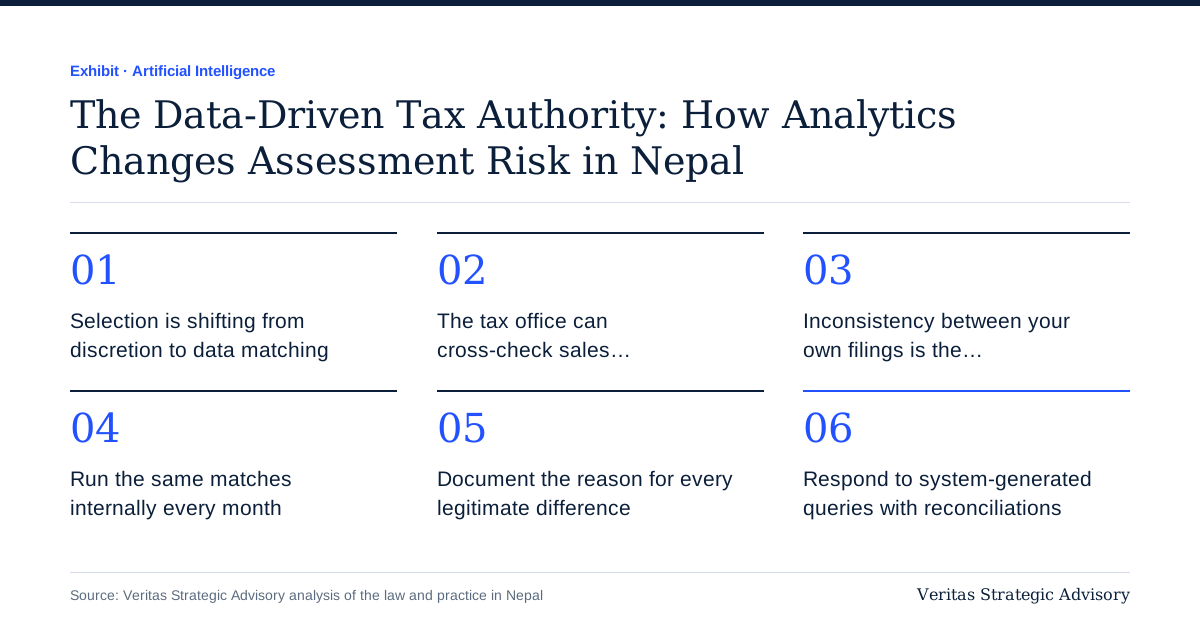
The most useful response is to run the tax office's likely tests on your own data first. Six reconciliations, performed monthly as part of the close (redesigning the close), cover most of the exposure.
| Match | Agree this | To this | Typical legitimate differences |
|---|---|---|---|
| 1. Sales | Sales per ledger | VAT returns, and CBMS data where applicable | Exempt sales, exports, advances, credit notes, timing |
| 2. Purchases and input VAT | Purchase register and input credit claimed | Supplier invoices held, supplier VAT status | Non-creditable items, timing, imports |
| 3. Imports | Customs declarations | Purchase ledger and stock receipts | Goods in transit, duty and freight, exchange rates |
| 4. TDS | Expense ledgers by type | TDS deducted, deposited and reported in e-TDS | Below-threshold items, exempt payees, timing |
| 5. Payroll | Salary expense | Salary TDS, SSF and CIT contributions | Non-taxable allowances, staff outside SSF, timing |
| 6. Annual tie | Twelve months of VAT turnover | Income tax revenue, and financial statements given to lenders | Other income, exempt income, accounting adjustments |
For each, keep a one-page reconciliation showing the two figures, the differences and the reason for each. When a query arrives, the answer is already written.
Three further habits:
Check suppliers. Verify PAN and VAT registration when a vendor is created, and periodically for major suppliers.
Know your ratios. Track gross margin, net margin and the input-output VAT ratio each month. Understand why they move. Our business health check covers the main ones.
Review before the year closes. A tax health check before filing the annual return finds what the system would find.
Using analytics on your own side
The same techniques are available to taxpayers. A company can use analysis tools, including AI features, to test all its transactions for duplicates, missing TDS, unusual vendors and VAT coding errors. This is the internal counterpart of what the tax office is building (continuous assurance).
A warning belongs here. Using AI tools to answer questions of Nepali tax law is a different matter and much riskier. General chat tools make confident errors on rates, thresholds and section references (can AI be trusted on Nepali tax law). Use machines to find anomalies in data. Use qualified people to decide what the law requires.
When the system asks
If a notice or query arrives that appears to come from data matching:
Read exactly what is being compared. Identify the two figures and their sources.
Rebuild the comparison yourself. Often the difference is timing, classification or a credit note.
Respond within the time allowed, with the reconciliation and supporting documents (the first 14 days after an IRD notice).
Correct genuine errors promptly. Voluntary correction before assessment is generally better than waiting.
Do not explain away what you cannot support. A written explanation becomes part of the record.
Keep your rights in view. A system flag is a reason to ask, not a finding. Assessment requires reasons, and administrative review and appeal remain available (defending an assessment).
From ground level to policy level
At ground level, everything depends on the accounts clerk coding a purchase correctly, entering the supplier's PAN accurately, and deducting TDS at the right rate. The data-driven tax office raises the cost of small, routine errors.
At company level, tax consistency becomes a board matter. Directors should ask once a year whether the six matches are performed and what the unexplained differences are.
At the level of the tax system, there is much to welcome. Risk-based selection should direct scrutiny toward real risk and away from the compliant, reduce discretion, and widen the base by finding those outside the net. Nepal's tax-to-GDP ratio depends heavily on a narrow group of compliant taxpayers and on customs, and better targeting is in the interest of everyone already paying.
There are also policy questions that deserve attention as the system is built:
Transparency. Taxpayers should know in general terms what data is used and what kinds of tests are applied, as several administrations publish.
Human review. No assessment should issue on a system flag alone. The Dutch and Australian experiences show why.
A right to explanation. A taxpayer should be told which figures were compared.
Data quality. Matching is only as good as the PAN recorded on each transaction. Errors in third-party data will generate false queries.
Data protection. Nepal has the Individual Privacy Act 2075 but no comprehensive data protection law or authority. Large-scale integration of tax, identity and financial data needs clear rules on access, use and security.
Pre-filled information. An annual statement showing each taxpayer what the department holds, as India provides, turns enforcement data into a compliance aid.
Capacity. Officers need training to interpret scores, and taxpayers need a reasonable channel to correct errors without a full dispute.
The role of consulting and advisory firms
International firms and institutions have been central to this change worldwide. The IMF and World Bank provide technical assistance on revenue administration, including to Nepal. The OECD's Forum on Tax Administration publishes the frameworks most administrations follow. Large consulting and technology firms build the data platforms and analytics for tax authorities. On the taxpayer side, the major accounting firms have invested heavily in tax technology: engines that determine indirect tax, tools that reconcile filings across jurisdictions, and analytics that mirror what authorities run.
For a Nepali mid-sized company the relevant service is more modest: someone who understands both the accounts and the law, who will run the reconciliations, explain the differences, correct what is wrong and prepare the file before a query arrives. The value lies in the combination of data work and legal judgement. Either alone is insufficient.
That is the work we do. We carry out tax health checks and reconciliations of VAT, TDS and income tax data (tax advisory, VAT and tax filing), and we represent taxpayers in responding to notices and in administrative review and appeal (IRD assessment defence). We have no access to the department's systems or criteria, and nobody who claims to should be believed.
The next 90 days
Days 1 to 30. Run the annual tie for the last filed year: VAT turnover to income tax revenue to the financial statements given to lenders. List every difference and its reason. Do the same for TDS against expenses.
Days 31 to 60. Extend the six matches to the current year, month by month. Correct errors that are found, by amended return where appropriate and after advice. Verify the PAN and VAT status of the top fifty suppliers.
Days 61 to 90. Build the six matches into the monthly close. Start tracking margin and VAT ratios against prior periods. Review open years within the four-year window for unresolved inconsistencies and decide, with advice, how to deal with them.
Frequently asked questions
Is the Inland Revenue Department already using AI to select audits?
The 2083/84 budget announced an AI-driven e-assessment system, and the department's plans describe automated, risk-based selection. How much is operational is not public. Selection already uses risk criteria and data from e-filing, e-billing, e-TDS and customs.
What is the single most common trigger?
An unexplained difference between figures the taxpayer has itself reported: VAT turnover against income tax revenue, or expenses against TDS.
We are a small company below the e-billing threshold. Does this affect us?
Yes. Your returns, your suppliers' and customers' reports, TDS statements and customs data are all in the system regardless of e-billing.
Can a computer issue a tax assessment?
An assessment under the Income Tax Act or VAT Act is made by the department under the law, with reasons, and is open to review and appeal. A system can flag and score. The legal act remains the department's.
What if our supplier did not report the sale?
Your input credit may be questioned. Keep the tax invoice, proof of payment through banking channels and evidence of receipt of goods, and deal with compliant, verified suppliers.
Our margin is lower than our competitors'. Is that a problem?
It is a reason to be asked, not a wrong. Keep a short explanation of your pricing, costs and business model with supporting figures.
How far back can the department go?
Generally four years for an amended assessment under section 101, with longer reach in cases such as fraud. Confirm the position for your facts.
Does consistent data mean we will never be audited?
No. Some selection is random or sector-based, and large taxpayers are examined regularly. Consistent data makes any examination shorter and its outcome more predictable.
*This article is general guidance, not professional advice. It is based on published information about tax administration and does not describe the Inland Revenue Department's internal criteria, which are not public. Rules reflect our understanding for FY 2083/84 and should be confirmed for your situation.*