- QR payment transactions in FY 2024/25, up from 169m a year earlier, as reported
- 326m
- the year Nepal's credit information bureau was established
- 1989
- of clean account and repayment history is the practical minimum to prepare before a major application
- 12 months
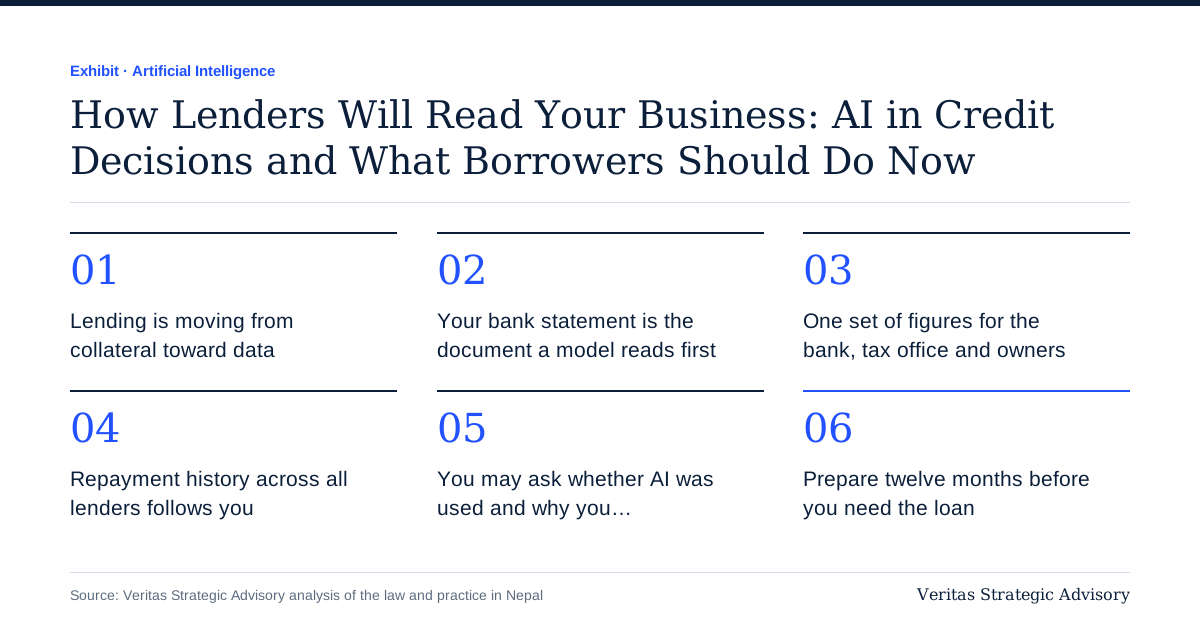
Ask a Nepali business owner how to get a bank loan and the answer has been the same for two generations: have land, preferably in the Kathmandu Valley, and know the branch manager. The credit file contained audited accounts that both sides understood to be approximate, a valuation of the property, and a relationship. The loan was sized to the land, not to the business.
This system produced credit, and it produced distortions. Businesses with strong cash flow and no land could not borrow. Businesses with land and weak cash flow borrowed too much. Money lent for working capital found its way into property and shares. When property prices stalled, as in recent years, non-performing loans rose and banks sat on liquidity they would not lend.
That model is changing, slowly and from several directions at once. This article explains how lenders will increasingly read a business through data and models, what that means in Nepal, and what an owner should do. It is the fourteenth in our series on artificial intelligence for business in Nepal.
A caution first. Banks do not publish their credit models, practices differ between institutions, and collateral remains central to most business lending in Nepal today. What follows describes a direction of travel, drawn from regulatory announcements, international practice and the logic of the data.
How credit decisions are changing
A credit decision answers two questions: will this borrower repay, and what do we lose if they do not? Collateral answers the second. Everything interesting is happening to the first.
Traditional assessment rests on the "five Cs": character, capacity, capital, collateral and conditions. A credit officer reads financial statements, visits the premises, checks the credit bureau report, values the security and writes an appraisal. It is slow, expensive per loan and dependent on the officer's judgement.
Credit scoring replaces part of that judgement with statistics. A model is built from the histories of past borrowers, identifying which characteristics predicted default, and gives each new applicant a score. Scoring for consumer credit has been standard in developed markets for decades.
Machine learning extends scoring to more variables and more complex patterns: hundreds of features drawn from account transactions instead of a dozen ratios from annual accounts.
Alternative data widens the inputs: mobile wallet and QR transactions, utility payments, e-commerce sales, tax filings, even supplier and customer networks. This is how lenders in India, China, Kenya and elsewhere have extended credit to small firms with no collateral and no audited accounts.
Generative AI is being applied around the decision: reading financial statements and documents, drafting credit memoranda, summarising the file. It is not, in responsible institutions, making the decision.
Monitoring is where the largest change may lie. A model that reads account activity monthly can flag deterioration, falling turnover, bounced cheques, growing reliance on the overdraft, long before an annual review would.
The evidence from other markets is that data-based lending does expand access for small businesses and reduce cost per loan. It also brings new problems: models that reproduce historical bias, decisions nobody can explain, and borrowers excluded because they have no data. Nepal has the chance to learn from both.
Where Nepal stands
The credit bureau. Karja Suchana Kendra, the Credit Information Bureau, was established in 1989 and holds borrowers' histories with licensed institutions: facilities, outstanding amounts, repayment status and the blacklist. Every bank consults it before lending (CIB blacklisting and removal).
Credit scoring. Nepal Rastra Bank has, as reported, been preparing to make credit scores a basis for assessing loan eligibility, moving the bureau from a negative list toward a graded score. Implementation is gradual, beginning with individuals and smaller loans.
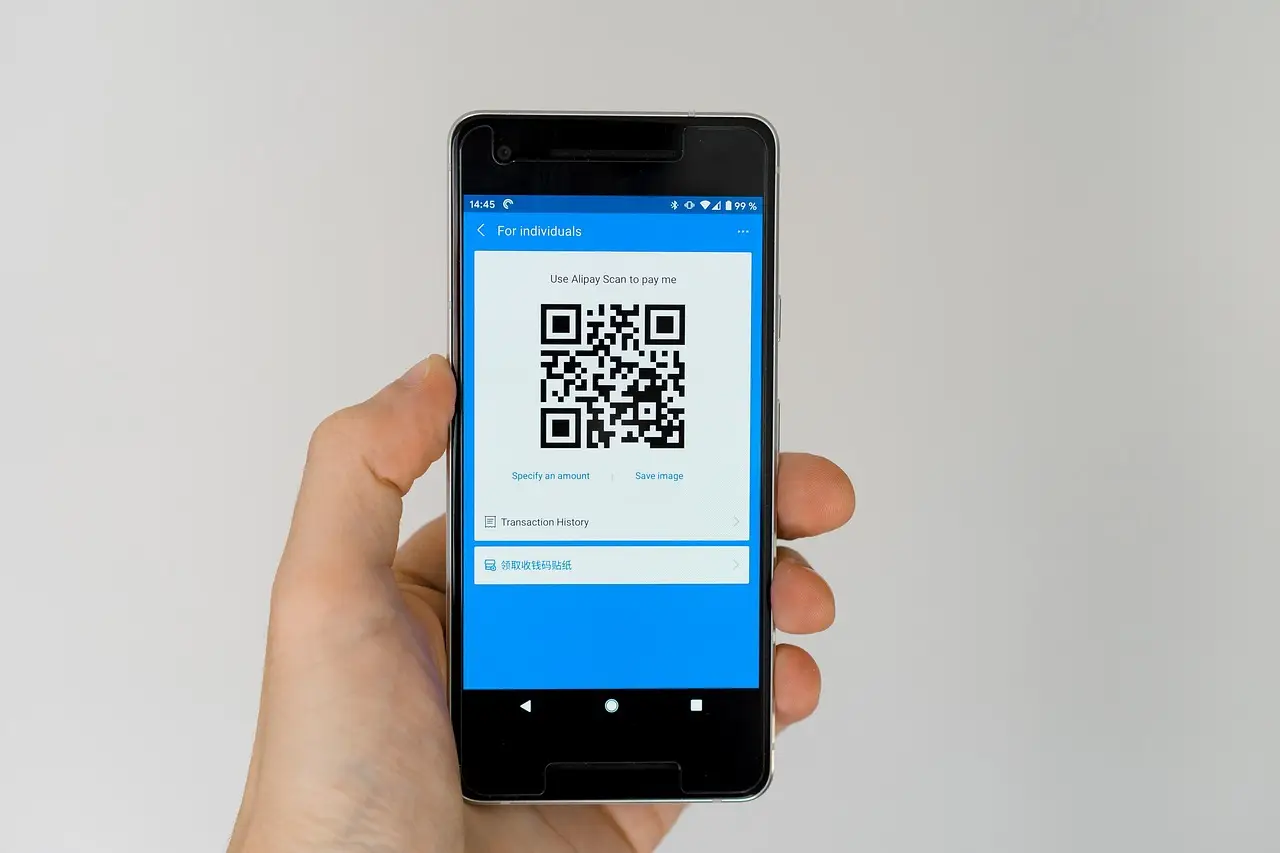
Digital payments. QR payment transactions roughly doubled in a year, from about 169 million in FY 2023/24 to 326 million in FY 2024/25, as reported from central bank data. Connect IPS, mobile banking and wallets are routine. A retailer who took only cash five years ago now has a daily electronic record of sales.
Tax data. PAN, VAT returns, e-TDS and e-billing create a verified record of turnover. Banks already ask for tax clearance and VAT returns.
The regulator's position on AI. In December 2025 Nepal Rastra Bank issued AI Guidelines for banks, financial institutions and payment operators. As reported, they require each AI system to be classified by risk before deployment, an AI governance framework within risk management, a steering committee, accountability of the board and senior management, disclosure to customers when AI is used in decisions affecting them, explainability, non-discrimination and human oversight. Credit decisions sit squarely within the high-risk category by any reasonable reading, as they do under the European Union's AI Act.
Policy direction. Successive monetary policies have encouraged lending on the basis of projects and cash flows, with collateral-free or lightly secured credit for small enterprises and start-ups, and have tightened working capital loan guidelines to tie limits to turnover (monetary policy and what it means for borrowers).
The reality. Most business lending still requires real estate security. Banks use internal risk rating systems, many of them scorecards combining financial ratios with judgement. Digital lending products for individuals and small merchants, with automated decisions, are emerging through banks and their fintech partners. Full machine-learning underwriting of business loans is not the norm, and anyone claiming otherwise is selling something.
What a lender's model can see
It helps to think as the model does. What data about a business is available to a bank, and what can be derived from it?
| Source | What it shows | Signals a model derives |
|---|---|---|
| Credit bureau report | All facilities with licensed lenders, repayment status, past dues, blacklist, enquiries | Days past due, restructuring, number of lenders, recent credit hunger, guarantor exposure |
| Current and overdraft accounts | Every credit and debit | Turnover through the account, seasonality, average balance, overdraft utilisation, cheque returns, cash share, concentration of payers and payees |
| Loan accounts | Instalment and interest payments | Timeliness, payment on the due date or after reminders, source of repayment |
| Financial statements | Revenue, margins, leverage, working capital | Ratios and trends, and consistency with account turnover and tax returns |
| VAT and tax returns | Declared turnover and profit | Agreement with accounts and bank credits, compliance regularity |
| QR and wallet data | Daily merchant receipts | Sales volume, stability, growth, customer count |
| Stock and receivables statements | Drawing power | Ageing, concentration, movement against sales |
| Security valuation | Realisable value | Loan to value |
| Group and related parties | Common owners, guarantees, fund flows | Group leverage, diversion to related entities |
| Application and KYC data | Age of business, sector, location, ownership | Sector risk, vintage |
| Public and registry data | Company filings, litigation, news | Compliance, disputes |
The first two rows matter most. A bureau report cannot be argued with, and the bank statement is the one document about your business that the bank knows to be true, because it wrote it.
What the data rewards and penalises
Whatever the sophistication of the model, the signals it finds predictive are remarkably stable across markets.
Rewarded
Sales routed through the account. Credits to the account that approximate declared turnover. This is the single strongest evidence of capacity.
Regularity. Receipts and payments in a steady pattern, or a seasonal pattern that repeats year to year.
Clean repayment. Every instalment and interest payment on or before the due date, from business receipts, without reminders.
Headroom. An overdraft that swings, used and repaid, with average utilisation well below the limit.
Consistency across documents. Turnover in the accounts, the VAT returns and the bank statements telling the same story.
Tax compliance. Returns filed on time, tax clearance current.
Diversification. No single customer or supplier dominating.
Vintage and stability. Years in business, stable ownership, the same bank relationship.
Equity. Owners' money in the business, profits retained.
Penalised
Any past due, even of a few days, and worse if repeated. Restructuring and rescheduling.
Cheque returns, issued or received.
An overdraft stuck at the limit, behaving like a term loan.
Loan repayments funded by fresh borrowing, or a rush of credits just before the due date.
Many recent enquiries and facilities at several institutions.
High cash share: large cash deposits and withdrawals with no trace of origin or destination.
Circular and related-party flows: money moving between group accounts to inflate turnover.
Funds leaving for purposes other than the business: property, shares, personal accounts.
Mismatch: accounts showing turnover that neither the bank account nor the VAT returns support.
Falling turnover or margins, lengthening receivables.
Guarantees given for others' loans, which are contingent debt.
Notice how many of these are habits and how few are matters of size or wealth. A small business with disciplined banking can score better than a large one with chaotic accounts.
The problem of two sets of books
It has long been common for a business to prepare one set of figures for the tax office, showing modest turnover and profit, and a rosier set for the bank. Banks knew, discounted both, and lent against the land.
Data-based lending makes this practice untenable for three reasons. The model checks the accounts against account credits and VAT returns, and a mismatch is itself a negative signal. Document identification and electronic filing of audited statements, where used, make it harder to circulate different versions. And the tax office is building the capacity to compare what it receives with what lenders hold (the data-driven tax authority).
The uncomfortable arithmetic is this. A business that under-declares turnover saves tax and loses borrowing capacity, because the model will lend against the turnover it can verify. For a growing business that needs credit, honest numbers are usually worth more than the tax saved. That is before counting the legal risk.
An illustration: two borrowers
These are invented examples for illustration, not clients.
Borrower A is a wholesaler with turnover of about NPR 12 crore. It owns land valued at NPR 6 crore. About half its sales are collected in cash and used to pay suppliers directly without passing through the bank. Its VAT returns show NPR 7 crore. Its audited accounts, prepared for the bank, show NPR 11 crore. The overdraft of NPR 2 crore has been at 95 per cent or more of the limit for two years. Twice in the last year, interest was paid a week late.
Borrower B is a distributor with turnover of NPR 9 crore and rented premises. All receipts come by QR, bank transfer or cheque into one account, and suppliers are paid from it. VAT returns, accounts and bank credits agree within two per cent, with a reconciliation. The overdraft of NPR 1.2 crore swings between 30 and 80 per cent. No payment has been late in four years.
Under the old model, A borrows easily and B struggles. Under a data-based model, B is plainly the better credit: verified turnover, demonstrated repayment capacity and consistent records. A is still protected by collateral, but the bank can verify only NPR 5 to 7 crore of turnover, sees a hard-core overdraft and late payment, and under turnover-linked working capital guidelines may find the existing limit hard to justify.
The transition will not be clean. B may still be asked for collateral for some years. The direction favours B.
What borrowers should do now
A twelve-month programme, because behavioural data takes time to accumulate and cannot be manufactured in the month before an application.
1. Put the business through the bank
Deposit all sales. Pay suppliers, salaries and taxes by transfer. Give customers QR and bank options and encourage their use. Stop paying suppliers out of the till. The aim is that the account's credits explain the turnover.
2. Separate business and personal money
One or more accounts used only for the business. Owners draw a salary or dividend into a personal account and spend from there. Mixed accounts are unreadable to a model and to a credit officer.
3. Never miss a due date
Set standing instructions for instalments. Keep a buffer in the account before the date. If a difficulty is coming, speak to the bank before the due date, not after. One late payment stays on the record for years.
4. Manage the overdraft as a revolving facility
If it never comes down, part of it is really a term need. Ask the bank to restructure that part into a term loan while the record is clean, and let the remainder swing (how much working capital a business needs).
5. Keep one set of figures
Accounts, VAT returns, income tax return and bank statements that reconcile, with a one-page reconciliation explaining differences. Have the accounts audited on time.
6. Check your credit bureau report
Obtain it before the bank does. Look for errors, old facilities not closed, guarantees you have forgotten and any past dues. Have errors corrected through the reporting institution.
7. Be careful with guarantees and group lending
A personal or corporate guarantee for a relative's or associate's loan is your exposure. Related-party fund flows should be documented, priced and limited.
8. Limit shopping around
Each application leaves an enquiry. Decide what you need, prepare properly and approach one or two lenders.
9. Report monthly
A business that can give its bank a monthly management summary, with sales, margins, receivables, stock and cash, demonstrates control and gives the relationship manager the material to argue your case (what a monthly management report should include).
10. Build the application as a case
Purpose, amount, repayment source, projections with assumptions, sensitivity and security. Calculate debt service cover before the bank does (what to calculate before taking a loan, EMI calculator). A model may screen, but a person usually still approves, and a coherent case matters (why banks reject loans).
Your rights when a machine is involved
The central bank's AI Guidelines, as reported, give borrowers at licensed institutions several protections in principle:
To be told when AI is used in a decision that affects you.
To an explanation. Institutions are expected to be able to explain the basis of AI-supported decisions.
To fair treatment. Systems must not discriminate unlawfully.
To human oversight. Accountability rests with the board and management, not the system.
In practice, a declined applicant should ask, in writing and courteously: was an automated system or score used; what were the principal reasons for the decision; what data was relied on; and how can errors in that data be corrected. Ask for review by a credit officer if you believe the data was wrong. If unresolved, banks have grievance procedures and the central bank operates a grievance mechanism.
Under the Individual Privacy Act 2075 your personal information should be collected and used with consent and for the stated purpose. When a lending application or app asks for access to your data, such as transaction history from a wallet or phone data in some digital lending apps, read what you are consenting to. Borrow only from licensed institutions. Unlicensed app-based lenders have caused serious harm to borrowers in neighbouring countries.
Risks in the model itself
Borrowers and policymakers should be clear-eyed about what can go wrong.
Thin files. A business with no borrowing history and cash-based sales has no data. A model cannot score what it cannot see, and may exclude exactly those the policy wants to include.
Bias. A model trained on past lending learns past patterns: lending concentrated in certain districts, sectors and communities, and among men. Unless tested and corrected, it will reproduce them. Women entrepreneurs, who are less likely to hold land in their own names, could benefit from cash-flow lending or be disadvantaged by a model trained on collateral-era data.
Opacity. Complex models can be hard to explain. A borrower who cannot learn why they were declined cannot improve.
Data errors. Wrong entries in a bureau record or a misattributed account can do lasting harm if correction is slow.
Procyclicality. Models tighten together in a downturn, amplifying it.
Gaming. Once borrowers learn what is rewarded, some will fabricate it: circular transactions to inflate account turnover. Models and regulators then respond, and the honest are caught in the tightening.
Shocks. Nepal's history of earthquake, blockade, pandemic and political disruption means past data may be a poor guide. Human judgement on context remains necessary.
From ground level to policy level
On the ground, the change begins with a shopkeeper in Butwal who puts a QR code on the counter and deposits the day's cash, and in doing so starts building a record that a lender can read. Three years of that record may be worth more than a land certificate.
At company level, banking discipline and consistent reporting become part of financing strategy. The finance head and the owner should review the business's "credit readiness" each quarter, as they review sales.
For banks, the task is harder than buying software. It requires clean internal data, validated models, staff who understand them, governance as the guideline demands, and the patience to let cash-flow lending prove itself through a cycle before scaling it.
At policy level, several things would determine whether data-based lending serves Nepal well:
A full-file, scored credit bureau that includes positive data, covers cooperatives and microfinance as well as banks, and gives every borrower easy access to their own report and a quick route to correct errors.
Consent-based data sharing. India's account aggregator framework lets a borrower share bank, tax and other financial data with a lender digitally, with consent. A comparable arrangement in Nepal, linking bank data, tax filings and payment data under the borrower's control, would do more for small business credit than any subsidy.
A secured transactions regime that works for movable assets, so that stock, receivables and equipment can stand as security in practice, not only in law.
Data protection law and an authority, so that the expansion of data use is matched by rights.
Model governance in supervision. The AI Guidelines are a start. Supervisors will need the capacity to examine models for accuracy and bias.
Financial literacy aimed at business owners: how scores work and how to build one.
The role of consulting and advisory firms
Internationally, the large consulting firms build credit models and decision systems for banks, advise on model risk management and validate models for regulators and boards. Credit bureaus and analytics companies supply scores and platforms. Development institutions, including the World Bank Group and the Asian Development Bank, have supported credit infrastructure and small-business finance programmes in Nepal and the region. Their published work on digital credit is a useful guide to what has worked elsewhere.
On the borrower's side the need is simpler and widely unmet. Most owners have never seen their own credit report, do not know their debt service cover and submit applications that make the credit officer's job harder. An adviser's value lies in preparing the business to be read: clean books, reconciled figures, a credible forecast and a case the bank can approve. An adviser cannot and should not promise approval, and anyone offering to "arrange" a loan through influence is offering something a data-based system is designed to remove.
Our work for borrowers covers bank loan documentation including projections and credit files, bookkeeping and monthly reporting that produce figures a lender can rely on, financial modelling and ongoing finance leadership through a virtual CFO. We do not lend, broker loans or have any arrangement with lenders, and the credit decision is always the bank's.
The next 90 days
Days 1 to 30. Obtain your credit bureau report and review it. List all facilities, guarantees and due dates. Compare last year's turnover in the accounts, VAT returns and bank credits, and write down the differences. Set standing instructions for every instalment.
Days 31 to 60. Open or designate business-only accounts. Move collections to QR and bank transfer and suppliers to transfer payment. Start a monthly management summary. Calculate debt service cover and overdraft utilisation for the last twelve months.
Days 61 to 90. Discuss with your bank converting any hard-core overdraft into a term loan. Correct bureau errors. Agree with your accountant that one set of figures will serve bank, tax office and owners from this year on. Set a quarterly review of credit readiness.
Frequently asked questions
Are banks in Nepal already using AI to approve loans?
Automated scoring is in use for some retail and small digital loans, and banks use internal rating scorecards. Most business loans are still appraised by credit officers and secured on property. The use of data and models is increasing, under the central bank's AI Guidelines.
Will I still need collateral?
For most business loans today, yes. The direction of policy is toward cash-flow-based lending, and good data already improves terms, limits and speed even where collateral is taken.
What is a credit score and can I see mine?
A number summarising your credit history. Nepal's credit bureau is moving toward scoring. You can request your own credit report through the bureau's procedures or your bank.
Does one late payment really matter?
Yes. Repayment history is the strongest single predictor in any model, and a past due remains visible for years.
My sales are mostly cash. What should I do?
Deposit all sales daily, offer QR payment, and pay expenses from the account. Within a year the account will show your true turnover.
Can a bank reject me purely by computer?
Under the central bank's guideline, institutions remain accountable for AI-supported decisions, should disclose the use of AI and should be able to explain them. Ask for the reasons and for human review.
Is it risky to give a lender access to my wallet or bank data?
With a licensed institution and clear consent terms it is how digital lending works. Read the consent, share only what is needed and avoid unlicensed lending apps.
Should the figures I give the bank match my tax returns?
Yes. Mismatch is a negative signal to lenders and a risk with the tax office. Where legitimate differences exist, provide a reconciliation.
*This article is general guidance, not professional advice. It describes trends in credit assessment based on published sources. Individual banks' policies and models differ and are not public. Descriptions of regulatory guidelines are summaries and should be confirmed against the original texts.*