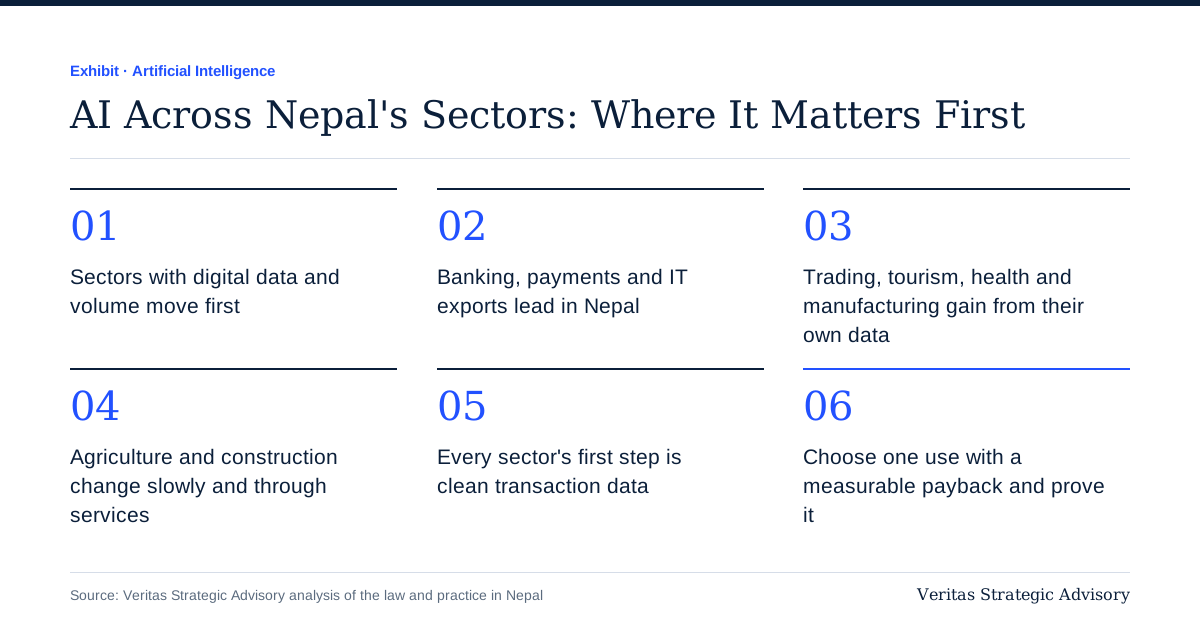
- conditions decide the order: digital data, scale, competitive pressure and skills
- 4
- of Nepali workers are in farming and manual work with low exposure to AI, per the World Bank
- 60%+
- sectors assessed below, each with a first use worth trying
- 12
Most writing about AI by industry is produced for economies whose structure is nothing like Nepal's. A global report will say that the largest value lies in software engineering, customer operations, marketing and research and development, and will illustrate it with a pharmaceutical company's drug discovery or a retailer's supply chain of ten thousand stores. That is true and of limited use to a cement manufacturer in Nawalparasi or a hotel in Pokhara.
Nepal's economy has its own shape. Agriculture employs most of the workforce and contributes roughly a quarter of output. Remittances amount to around a quarter of GDP and finance much of consumption. Trade, largely the import and distribution of goods, is the largest part of commerce. Manufacturing is small. Hydropower is the major investment story. Tourism is the visible export, and IT services the fast-growing one. Most firms are small and family-owned.
The question for this article is where, in that economy, AI will make a practical difference first, and what an owner in each sector should do. It is the fifteenth in our series on artificial intelligence for business in Nepal, and builds on the earlier pieces on where the value is and data readiness.
The assessments are our judgement from published information and the structure of each sector, not a survey. No reliable sector-level data on AI adoption in Nepal exists.
What decides the order
Four conditions determine how soon AI produces value in a sector.
Digital data. AI works on data in systems. A bank has every transaction in a core banking system. A construction contractor has site diaries on paper. The gap between them is not intelligence, it is raw material.
Scale and repetition. Value comes from doing a task thousands of times. A payment operator processing a million transactions a day has a use for fraud models. A consultancy writing forty reports a year does not have a use for a custom model, though it has plenty of use for general tools.
Competitive or regulatory pressure. Firms change when they must. Exporters competing with Indian and Filipino vendors must. A protected or cartelised trade need not.
Skills and capital. Someone must choose the tool, fit it to the process and maintain it, and someone must pay for it in dollars.
A fifth factor cuts the other way: regulation and consequence. In health, credit and law, the cost of a wrong answer is high, so adoption is properly slower and more controlled.
Scored against these conditions, Nepal's sectors fall into three waves.
| Wave | Sectors | Why |
|---|---|---|
| First: under way | Banking and payments, IT and outsourcing exports, telecom, insurance | Digital data, volume, regulation or export competition, skilled staff |
| Second: next three to five years | Trading and distribution, modern retail, tourism and hospitality, hospitals, larger manufacturers, hydropower, professional services, education | Data partly digital, moderate scale, gains mainly from analytics and general tools |
| Third: slow and indirect | Agriculture, construction and real estate, small retail and informal services, most of the public sector | Little digital data, small units, low capital. Effects arrive through services from others |
First wave
1. Banking, microfinance and payments
Why first. Banks hold years of structured transaction data, operate at volume, are supervised by a regulator that has now issued specific guidance, and employ technology staff. Digital payments have grown very fast: QR transactions roughly doubled in a year to about 326 million in FY 2024/25, as reported.
Realistic uses now.
Fraud detection on cards, mobile banking and QR, and screening for money laundering, where rule-based systems produce large numbers of false alerts.
Customer service assistants in Nepali and English for routine queries.
Document handling: reading KYC documents, financial statements and security papers.
Early warning on loan accounts from transaction behaviour.
Credit scoring for small retail and merchant loans (how lenders will read your business).
Internal productivity: drafting credit memos, policy search, code assistance.
What holds it back. Data spread across legacy systems, vendor dependence for core banking, a shortage of data scientists, and proper caution about explainability in credit.
Governance. Nepal Rastra Bank's AI Guidelines of December 2025 require, as reported, risk classification of each system, a governance framework and steering committee, board accountability, disclosure to customers and human oversight. Deepfake-enabled fraud is named as a risk.
First use worth trying. Reducing false positives in transaction monitoring, or an early-warning model on the existing loan book. Both use the bank's own data and have measurable results.
Microfinance and cooperatives hold data on millions of small borrowers and savers but with much weaker systems. For them the first step is reliable core software and reporting, which is also what their regulators are demanding after recent failures in the cooperative sector.
2. IT services and outsourcing exports
Why first. This is the sector AI affects most directly, for better and worse. Nepal's IT exports were estimated at about USD 515 million in 2022 and industry sources put them near USD 1 billion in 2025. The work, software development, testing, data processing, back-office finance and customer support, is precisely what generative AI performs or accelerates.
The threat. The World Bank's South Asia update reported that generative AI had cut job postings in customer service and software development by around a fifth globally. A business that sells hours of routine coding, data entry or first-line support is selling something whose price is falling.
The opportunity. A developer using AI tools well produces more. Small Nepali firms can deliver what used to need larger teams. Demand is rising for exactly the work AI creates: data preparation, model evaluation, integration, AI-assisted operations and oversight.
What to do.
Adopt AI coding and testing tools as standard, with client consent, and measure the gain.
Move pricing from hours toward outcomes before clients force it.
Build services around AI: data annotation and evaluation, integration, managed processes with human review.
Obtain recognised security and privacy certifications, and a clear written position on AI use with client data. Foreign clients now ask (AI risk as a governance question).
Train continually. The half-life of technical skill has shortened.
Policy context. Tax concessions on IT export income have been reduced in recent budgets, as reported, while the 2083/84 budget opened IT services further to foreign investment and announced a sovereign compute centre. See registering an IT or BPO company with FDI and our piece on Nepal's AI opportunity.
3. Telecom and internet services
Why first. Operators have enormous volumes of network and customer data and established analytics teams.
Uses. Network fault prediction and optimisation, churn prediction, customer service automation, fraud control and targeted offers. Internet service providers, a competitive trade in the cities, can use the same for service quality and collections.
Constraint. Investment capacity under revenue pressure, and ownership and licence uncertainties in parts of the sector.
4. Insurance
Why early. Data on policies and claims, growing volumes, and a regulator pressing for consolidation and capital.
Uses. Claims triage and fraud detection, particularly in motor and health; underwriting support; document extraction; customer service; agricultural and micro-insurance using weather and satellite indices, which may be the most valuable application for the country.
Constraint. Legacy systems, data quality and actuarial capacity. The Insurance Authority has not, to our knowledge, issued AI-specific guidance, and insurers should expect it and follow the central bank's guideline as a reference.
Second wave
5. Trading, import and distribution
This is the commercial heart of the economy, and almost all of it runs on accounting software and spreadsheets.
Uses with real payback.
Demand forecasting and stock. Statistical forecasts by item and location, reorder points that reflect lead times from India and China, and identification of slow stock. In a business where stock and receivables are financed at 10 to 13 per cent, a few days' reduction is real money (forecasting under uncertainty).
Receivables. Scoring customers by payment behaviour and prioritising collection.
Landed cost and pricing. Analysing margins by item after duty, freight and exchange movements (landed cost and LC management).
Document handling. Reading supplier invoices, customs documents and bank advices into the books.
Sales force. Route planning and order prediction for distributors.
Constraint. Item and customer masters in poor order, stock records that do not match the godown, and owners who hold the business in their heads.
First use. A clean item master and a simple forecast for the top two hundred items. It needs a spreadsheet, not AI, and it prepares the ground.
6. Modern retail, e-commerce and consumer brands
Supermarket chains, e-commerce platforms and delivery businesses have point-of-sale and app data at volume. Uses: assortment and pricing, promotion analysis, recommendation, delivery routing, customer service and loss prevention at tills. The many thousands of small shops are in the third wave, though QR payments are giving them a data trail for the first time.
7. Tourism and hospitality
Nepal receives over a million visitors a year, with sharp seasons and heavy dependence on online travel agencies.
Uses.
Pricing and revenue management. Dynamic room rates from booking pace, season, events and competitor rates. Standard practice in hotel chains worldwide, rare in Nepali independents.
Guest communication. Multilingual enquiry handling and itinerary drafting, at any hour, in the visitor's language.
Marketing content. Descriptions, translations and review responses.
Review analysis. Reading thousands of reviews for recurring complaints.
Forecasting occupancy, staffing and purchasing (seasonal cash flow in hotels).
Constraint. Small properties, basic property management systems, and commission paid to platforms that own the customer data.
A caution. Trekking and mountaineering involve safety. AI-written itineraries and advice on altitude, weather and routes must be checked by people who know the ground.
First use. A rate calendar driven by booking pace, and an assisted enquiry desk with human sign-off.
8. Hospitals, clinics and pharmacies
Administrative uses, lower risk. Billing and insurance claims, appointment scheduling, pharmacy stock and expiry, collections, and coding (finance and tax in hospitals). The national health insurance programme's claims process is a large potential beneficiary of automated checking on both sides.
Clinical uses, higher risk. Reading of X-rays and scans, screening for tuberculosis and diabetic eye disease, and decision support have genuine promise in a country short of specialists outside the Valley. They require validated tools, professional oversight, patient consent and regulatory attention. Patient data is among the most sensitive categories under the Individual Privacy Act 2075.
First use. Claims and billing accuracy, and pharmacy stock.
9. Manufacturing
Cement, steel, food and beverages, pharmaceuticals, garments, carpets, plastics and bricks. Mostly mid-sized plants, with a handful of large ones.
Uses.
Energy and yield. In cement, steel and brick, energy is the largest cost. Analysis of process data for fuel and power per tonne has a direct payback.
Predictive maintenance. Vibration and temperature monitoring on critical equipment, where sensors exist.
Quality inspection. Camera-based inspection on packaging and bottling lines.
Costing and margin. Product and customer profitability from existing data (costing and inventory control in manufacturing).
Planning. Production and raw material planning against demand forecasts.
Constraint. Old plant with little instrumentation, power quality, and capacity utilisation so low in several industries that efficiency is not the binding problem. Demand is.
First use. Monthly energy and yield analysis by line and shift from data already recorded.
10. Hydropower and energy
Installed capacity has passed 3,000 megawatts and is growing, with seasonal surplus exported to India and Bangladesh.
Uses.
Hydrology and generation forecasting. River flow prediction from rainfall, snow and upstream data improves energy scheduling and revenue in a system with take-or-pay and penalty terms.
Predictive maintenance of turbines, generators and transformers.
Sediment management, a major cause of wear in Himalayan rivers.
Grid operations. Load forecasting, loss detection and smart meter analytics for the utility.
Trading. Bidding into the Indian power exchange needs price and demand forecasts.
Policy link. The 2083/84 budget connects hydropower to AI directly, proposing to use domestic electricity for compute services. Whether that is commercially viable depends on connectivity, cooling, reliability and demand, which we consider in the next article. See also hydropower finance.
First use. Inflow and generation forecasting for plants with several years of data.
11. Professional services
Accounting, law, engineering consultancy, architecture and consulting. Small firms, text-heavy work.
Uses. Drafting, summarising, research assistance, document review, translation between Nepali and English, data analysis and presentation. The gain per person is high and the investment low.
Risks. Confidentiality of client information, fabricated references, and weak coverage of Nepali law in the tools (can AI be trusted on Nepali tax law). Professional responsibility is not reduced by the use of a tool.
First use. Approved tools for drafting and summarising with a firm rule on client data and review.
12. Education and training
Private schools, colleges, consultancies preparing students for study abroad, and training institutes.
Uses. Administration, admissions and fee collection; lesson preparation; personalised practice; language learning; assessment support.
Issues. Academic integrity, the temptation to substitute tools for teaching, student data, and unequal access. Institutions need a policy on student and teacher use.
The larger point. What the education system teaches about data and AI will decide how the country fares, and that is a matter for the final article in this series.
Third wave
Agriculture
Most Nepalis who work, work on the land, on small and fragmented plots. No farmer with half a hectare in Sindhuli will buy an AI system. The benefits, if they come, come through services:
weather and pest advisories by phone in Nepali and local languages, including voice for those who do not read;
crop disease identification from a photograph;
price information across markets;
index insurance and credit scored from satellite and weather data;
better planning of fertiliser and seed distribution, a chronic failure of public supply;
traceability and grading in export crops such as tea, coffee, cardamom and ginger;
commercial dairy and poultry, which are organised businesses with real data and belong in the second wave.
The binding constraints are extension services, connectivity, literacy, land fragmentation and who pays.
Construction, real estate and infrastructure
Project-based, paper-heavy and fragmented among contractors and subcontractors. Useful applications exist in estimation, scheduling, progress monitoring from photographs and drones, contract and claims analysis and bid preparation, and larger contractors and developers should experiment. Chronic delay and cost overrun in public projects have causes, land acquisition, budgeting, procurement and contract management, that data can illuminate and cannot cure.
Small retail and informal services
The corner shop, the tailor, the workshop, the tea stall. Their route into the data economy is the QR code, the wallet and a simple billing app, and through those to credit. For this group, payments are the on-ramp and AI is something done by the bank or platform that serves them.
Public sector
Government holds the largest datasets in the country: tax, customs, land, vehicles, citizenship and the National ID, health insurance, social security, procurement. Tax administration has announced AI-driven selection (the data-driven tax authority). Elsewhere, service delivery is held back by the basics: systems that do not talk to each other, the Nagarik app's uneven coverage, and the need to visit an office with paper. The Oxford Insights readiness index ranked Nepal 150th of 193 governments in its 2023 edition. For business, the practical importance of the public sector's progress is as supplier of data and services: a land record or company registry that can be queried reliably is worth more to the economy than any model.
What every sector has in common
Read across the twelve sectors and the same points recur.
The first step is not AI. In almost every case the first use worth trying is analysis of the company's own transaction data, and the obstacle is the state of that data.
General tools reach everyone. Drafting, summarising, translation and spreadsheet help are useful in every office in the country today, at the cost of a subscription. This is where most Nepali firms will first feel AI.
Language matters. Tools work better in English than in Nepali, and far better in Nepali than in Maithili, Bhojpuri, Tharu, Tamang or Newari. Customer-facing applications must be tested in the languages customers speak.
Finance and tax functions are a common starting point in every sector, because the data is structured and the tasks repeat (the CFO's office in 2030).
Dollars and dependence. Almost every tool is foreign and priced in foreign currency.
People decide the outcome. The evidence from global surveys is consistent that most of the difficulty lies in process and people, not algorithms (why AI programmes fail).
A sector summary
| Sector | First use worth trying | Main blocker | Horizon |
|---|---|---|---|
| Banking and payments | Fraud false-positive reduction, early warning | Legacy data, model governance | Now |
| IT and outsourcing | AI-assisted delivery, new service lines | Pricing model, skills | Now |
| Telecom and ISPs | Churn and fault prediction | Investment capacity | Now |
| Insurance | Claims triage and fraud | Systems, actuarial skills | Now to 2 years |
| Trading and distribution | Item-level forecast and stock | Master data | 1 to 3 years |
| Modern retail | Assortment and promotion analysis | Analytics skills | 1 to 3 years |
| Tourism and hospitality | Rate management, enquiry handling | Small scale, platform dependence | 1 to 3 years |
| Hospitals | Claims and billing accuracy | Systems, privacy | 1 to 3 years |
| Manufacturing | Energy and yield analysis | Instrumentation, low utilisation | 2 to 5 years |
| Hydropower | Inflow and generation forecasting | Data history, specialist skills | 1 to 3 years |
| Professional services | Drafting and review with controls | Confidentiality, accuracy | Now |
| Education | Administration, lesson preparation | Policy, integrity | Now to 2 years |
| Agriculture | Advisory and insurance via services | Extension, connectivity, who pays | 5 years and more |
| Construction | Estimation and progress monitoring | Fragmentation, paper | 3 to 5 years |
| Public sector | Tax risk selection, registries | Integration, capacity | Uneven |
From ground level to policy level
On the ground, the sector differences come down to whether the person doing the work has data on a screen. The teller does. The mason does not.
At company level, an owner should place the business honestly in its wave and act accordingly: first-wave firms need governance and skills now, second-wave firms need clean data and one proven use, third-wave firms should adopt digital payments and simple records and wait.
At sector level, associations have a role that individual small firms cannot play: the hotel association negotiating shared revenue tools, the IT association setting standards on AI use with client data, the bankers' association pooling fraud intelligence, cooperatives' federations procuring common systems.
At policy level, a sector view suggests priorities different from the usual emphasis on compute and research. The largest economy-wide gains would come from digital public infrastructure that makes every sector's data usable: reliable registries, interoperable identity, consent-based data sharing, e-invoicing extended down the size range, and open public datasets on weather, hydrology, prices and land. Sector regulators beyond the central bank need to state their expectations. And the sectors that employ the most people, agriculture above all, will be reached only by public or cooperative services, since no market incentive will deliver AI to a smallholder.
The role of consulting and advisory firms
The global consulting firms organise their AI work by industry and publish sector outlooks estimating value at stake. McKinsey's 2023 analysis, for example, placed about three quarters of generative AI's potential value in customer operations, marketing and sales, software engineering and research and development, with banking, high technology and life sciences among the most affected industries. These reports are useful for direction and for a catalogue of use cases. They describe companies with tens of thousands of employees and mature data, and their value estimates should not be scaled down arithmetically to a Nepali firm.
In Nepal, international firms and development partners work mainly with banks, the government and large projects. For the mid-sized company the useful adviser is one who knows the sector's economics and the company's books, and who will say plainly that the first step is a clean item master and a monthly margin report. An adviser should never be paid by the software vendor being recommended.
Our role is sector-specific finance and performance work: costing, margin, working capital and reporting (business performance, data analytics and reporting), finance leadership through a virtual CFO, and automation of routine finance processes (process automation). Our guide to management consulting by industry and the industries page set out how the work differs by sector. We do not sell or resell software.
The next 90 days
Days 1 to 30. Place your business in its wave. List the data you hold in systems and its condition. Identify the three decisions you make most often with least information: pricing, stock, credit, staffing or maintenance.
Days 31 to 60. Pick the first use from the table for your sector, or a better one of your own. Define the measure of success in rupees or days. Clean the data that use requires. Give staff approved general tools with a short policy.
Days 61 to 90. Run the first use on real data for a month. Compare with what you did before. Decide to continue, adjust or stop. Talk to two peers in your sector association about what they have tried.
Frequently asked questions
Which sector in Nepal will AI affect most?
IT services and outsourcing most directly, because AI performs the work they sell. Banking and payments are furthest ahead in adoption because of their data and regulation.
Is AI relevant to a trading company?
Yes, through forecasting, stock, receivables and document handling. The first gains come from analysing data the company already holds.
Will AI help Nepali agriculture?
Potentially, through advisory, insurance and market services delivered by government, cooperatives and companies. Individual smallholders are unlikely to adopt tools directly.
We are a hotel with forty rooms. Where do we start?
A rate calendar that responds to booking pace and season, and assisted handling of enquiries and reviews, with a person approving what goes out.
Is it safe for hospitals to use AI?
Administrative uses carry modest risk with proper data protection. Clinical uses need validated tools, professional oversight and consent, and should be approached carefully.
Do manufacturers need sensors and new machinery first?
Not for the first step. Energy, yield and downtime data already recorded by shift is enough to begin. Predictive maintenance needs instrumentation.
How does my sector's regulator view AI?
The central bank has issued guidelines for banks and payment firms. Other regulators have yet to issue comparable guidance. Existing rules on privacy, confidentiality and consumer protection apply everywhere.
Should a small business wait?
For custom AI, usually yes. For digital payments, proper accounts and general tools used carefully, no. Those are the preparation.
*This article is general guidance, not professional advice. Sector assessments are the authors' judgement based on published information, and figures cited are from the sources listed or are approximate. Conditions differ between businesses.*