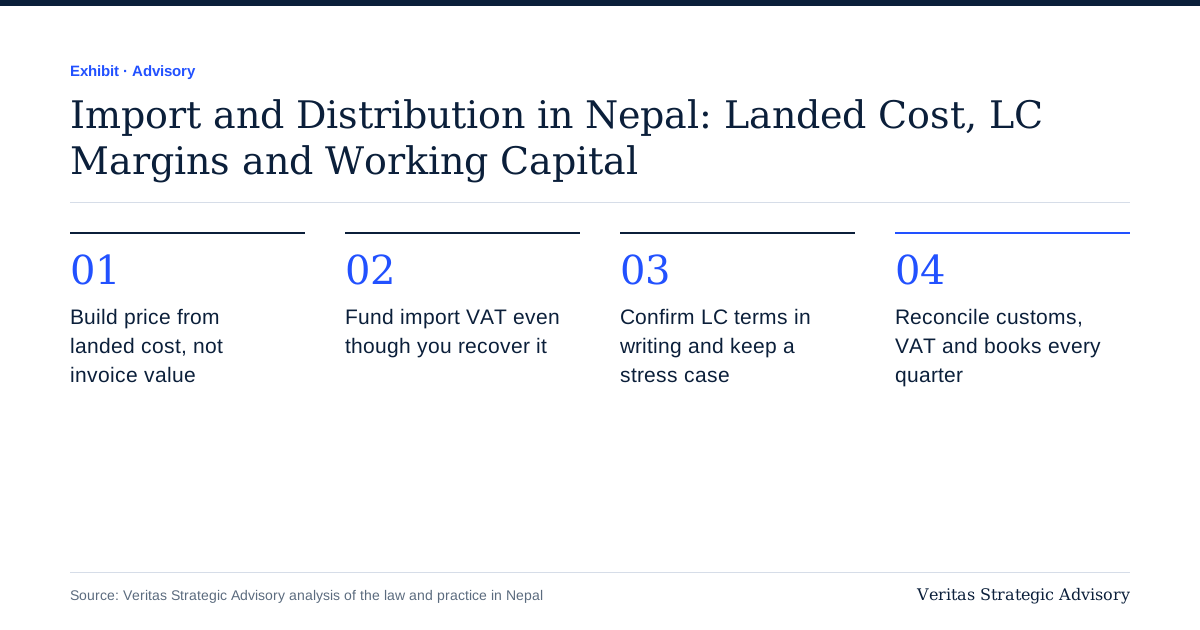
- cost layers above the CIF value
- 4
- VAT rate, charged on value plus duty
- 13%
- working capital stages to plan
- 4
- points in the checklist
- 8
Import and distribution looks simple from the outside: buy abroad, clear at customs, sell to retailers. Inside the business, most of the money is made or lost in three places: the cost you work out before you buy, the cash you lock up between paying the bank and collecting from the customer, and the paperwork that lets you recover VAT. This guide walks through each one for a Nepali importer or distributor, using figures that are illustrative so you can follow the logic. Rates change with every Finance Act, so confirm the rate for your product's HS code before you quote a price.
What goes into the landed cost of an imported product?
Customs in Nepal assesses imports on a CIF basis (cost, insurance and freight), following the GATT valuation system, as described in a summary of Nepal's import duty framework. That CIF value is the starting point, not the end. A reasonable landed cost has these layers:
| Layer | What it covers | Treatment |
|---|---|---|
| CIF value | Goods, insurance and freight to the Nepal border | Converted at the customs exchange rate |
| Customs duty and other border levies | Duty by HS code, plus any other levy charged at customs | Part of cost; confirm rates for the current year |
| Clearing and transport | Agent fee, port or dry-port handling, local trucking, demurrage | Part of cost |
| Finance cost | LC commission, margin deposit, interest on loan or overdraft | Part of cost for pricing; treat as finance expense in the accounts |
| Import VAT (13%) | Charged on CIF plus duty | Usually claimed as input credit, not a cost |
VAT in Nepal is 13% and the 2083/84 budget kept that rate, according to a summary of the budget's tax changes. The same summary notes that customs tiers were reduced and a new Green Tax now consolidates the earlier infrastructure development tax and road maintenance fee. Because the product mix and exact rates differ, we do not quote a duty rate here. Take the rate from the Department of Customs tariff for your HS code.
If you import liquor, tobacco or certain vehicles, there is a further layer on top of customs duty: excise duty, administered through excise stamps and the self-removal system. See our excise duty FAQ for how licensing, stamps and rates work for these goods.
How does a worked example look in rupees?
The numbers below are a hypothetical illustration, not a quote for any product. Assume a shipment with a CIF value of NPR 1,000,000 and an illustrative duty rate of 15%.
Customs duty: 15% of 1,000,000 = NPR 150,000.
VAT base: CIF plus duty = NPR 1,150,000. VAT at 13% = NPR 149,500.
Clearing and local transport: NPR 40,000 (assumed).
Landed cost before finance, excluding VAT: 1,000,000 + 150,000 + 40,000 = NPR 1,190,000.
Finance cost: if NPR 1,000,000 is financed at an assumed 11% a year for 120 days (shipping, clearing and holding), interest is about 1,000,000 x 11% x 120 / 365 = NPR 36,164.
All-in cost: about NPR 1,226,000.
If the lot sells for NPR 1,500,000 ex VAT, the gross margin on the all-in cost is about NPR 274,000, or 18.3% of sales. A manager who looked only at the invoice and clearing would have seen NPR 1,040,000 of cost and a margin near 30.7%. The 12-point gap is the duty and finance cost nobody counted.
The VAT of NPR 149,500 is not in these figures because it is recoverable against your output VAT. It still has to be paid at customs, so it is cash you fund for a few weeks. We explain the return side in our guide to VAT return filing and the monthly deadline and the recovery side in why VAT refunds get stuck.
How do LC margins and bank terms affect your cash?
An LC is the bank's promise to pay the overseas supplier once the shipping documents match its terms. For the importer it brings three costs: a commission, a margin deposit the bank may hold, and interest if the bank finances part of the payment.
The margin rules have moved a lot in recent years. In December 2021 the central bank tightened import rules, requiring cash margins on many categories of goods. In January 2023 Nepal Rastra Bank removed the LC margin imposed on imports of goods, after the foreign exchange position improved. We found no later primary circular, so do not assume today's position from news reports. Ask your bank which margin, if any, applies to your goods and write it into your costing.
Practical points when you negotiate an LC:
Ask whether the facility is sight or usance, and from which date the usance period starts. A 60-day usance that starts at the shipping date gives much less relief than one that starts at document receipt.
Check that the description of goods, quantity and HS code in the LC match your purchase order and the supplier's invoice. A mismatch can delay clearance and add demurrage.
Confirm whether the bank charges a separate commission for amendments.
Keep the exchange-rate risk visible: the supplier is paid in foreign currency, but you collect in rupees.
How much working capital does a distributor need?
Working capital for an importer is the cash tied up between paying the bank and collecting from customers. Four stages matter:
Order to shipment. Your margin deposit, if any, is already with the bank.
Shipment to clearance. Transit time, plus customs and agent delays.
Clearance to sale. Days of stock you hold, driven by how quickly the product moves.
Sale to collection. Credit days you give to retailers or sub-distributors.
Take a simple example, again hypothetical. The importer pays its bank on document receipt, then waits 30 days for the goods to clear, holds stock for 45 days and collects after another 30 days of credit. The cash is out for 105 days before it returns. If it also funds import VAT of NPR 149,500 until its next return, the real requirement is higher than the invoice suggests.
You can tighten this cycle without changing your supplier: negotiate a usance LC, consolidate shipments to avoid demurrage, hold fast-moving lines in depth and slow lines thin, and set credit limits by customer. For a deeper framework, read how much working capital your business needs, and what to calculate before taking a bank loan.
Why do lenders and the tax office care about import records?
Banks read your import and sales records together. A customs value that is very different from your invoice, or stock that does not reconcile to sales, makes a credit officer uneasy. Our note on why banks reject loans lists the patterns we see most. The tax office also compares customs data, VAT returns and the accounts. Keep these documents for every consignment: purchase order, commercial invoice, packing list, bill of lading or airway bill, customs declaration, bank advice for the LC, clearing agent invoice, and the stock entry.
For stock, record the landed cost in your accounting system so the inventory value and the cost of goods sold use the same figure that your pricing used. If your costing sheet and your books disagree, the gap usually shows up as a margin surprise at year end. Payments to foreign agents for commissions or services may also raise withholding questions; see our guide to TDS on foreign vendor payments.
An 8-point checklist for importers and distributors
Confirm the HS code and the current duty and other levies for every product line.
Build a landed cost sheet with the cost layers above, and refresh it for every shipment.
Price from landed cost plus finance cost, not from invoice value.
Ask your bank in writing about LC commission, margin deposit and usance terms.
Check that LC wording, purchase order and invoice agree before shipping.
Fund import VAT in your cash plan and file the return on time to recover it.
Review stock age monthly and cut slow lines before they absorb cash.
Reconcile customs data, VAT returns and accounts once a quarter.
Frequently asked
Is import VAT a cost to the importer?
Generally it is not, if the importer is VAT registered and the documents are valid. It is claimed as input credit against output VAT, but it needs cash at the time of import. Confirm eligibility on your invoices and returns.
What is the CIF value and why does it matter?
CIF means cost, insurance and freight. Customs assesses duty on this value, and VAT is charged on this value plus duty, so any error in the declared value flows through to every later number.
Is a cash margin on LCs required today?
NRB removed the LC margin on goods imports in 2023, but policy can change with the foreign exchange position. Ask your bank which terms apply to your goods now.
Should I include interest in my price?
Yes, for pricing. The financing cost of the LC and the stock is real. In the accounts it appears as a finance expense, and the costing sheet should still use it so the margin you quote is the margin you earn.
How often should I update the landed cost sheet?
Every shipment, and whenever the exchange rate, duty rate or freight rate changes. A quarterly review is too slow for products with thin margins.
Can Veritas help with import costing?
Yes. We help importers build costing models, plan working capital and prepare records for banks and tax review.
How Veritas can help
We help importers and distributors build landed cost sheets, plan working capital around LC terms and keep VAT and stock records that banks and the tax office can follow. See our business performance work, our VAT and tax filing service and our bookkeeping services, or contact us.
General information only, not advice.